Master Content Optimization for AI & Human Readers in 2026
Discover how to optimize content for both AI and human readers in 2026. Learn strategies that enhance visibility across Google SERPs and AI answer layers, ensuring your content earns citations and converts visitors.

Zakariae

The search landscape has fundamentally transformed. In 2026, approximately half of all US searches now occur within or alongside AI chat interfaces, including ChatGPT search, Perplexity, Gemini, and Google AI Overviews. This seismic shift means that traditional ranking strategies alone no longer guarantee visibility. The brands winning today understand a critical truth: content optimization now serves two masters simultaneously, the human reader and the AI engine deciding whether to cite your work.
For SEO agencies, content marketing managers, small business owners, and affiliate marketers, this dual reality creates both challenge and opportunity. The teams still producing content the same way they did in 2022 are watching their traffic erode despite maintaining classic rankings. Meanwhile, forward-thinking organizations are capturing visibility across both traditional SERPs and the AI answer layer that increasingly sits above them.
This playbook delivers the specific strategies, workflows, and structural approaches that drive results in 2026. Whether you manage content for a B2B SaaS company, run an e-commerce blog, or build niche affiliate sites, these principles will help you create content that ranks in Google, earns citations in AI Overviews, and converts visitors into customers.
Key Takeaways
- AI engines now determine visibility before users ever see traditional search results, making citation optimization essential alongside classic SEO.
- Structure trumps length in 2026, with self-contained passages, comparison tables, and FAQ schema outperforming keyword-stuffed long-form content.
- The 70/30 model works best: AI handles 70% of draft production while humans contribute judgment, expertise, and final editing.
- Entity clarity matters more than ever, as AI engines build knowledge graphs before deciding which sources to cite.
- Speed to publication has compressed from weeks to days, with indexation velocity becoming a competitive advantage.
- Pure AI-generated content underperforms on both traditional rankings and AI citations while risking Google's spam policies.
- Measurement has evolved to include AI share of voice and branded search lift alongside traditional position tracking.

Understanding the Dual Search Ecosystem of 2026
The search ecosystem has bifurcated into two distinct but interconnected surfaces. The first surface is the traditional Google SERP with its familiar blue links, featured snippets, and People Also Ask boxes. The second surface is the AI answer layer, where language models synthesize information from multiple sources and present users with direct answers before they ever scroll to organic results.
Data from Q1 2026 shows that AI Overviews now appear above organic results for approximately 44% of informational queries in the US market. When these AI-generated answers appear, position-one click-through rates drop by an average of 31%. However, brands that earn citations within these overviews experience a 12% increase in sustained branded search volume. The implications are clear: being ranked is no longer enough if you are not being cited.
This shift fundamentally changes how content teams must approach their work. The old playbook focused on ranking for keywords and capturing clicks. The new playbook requires earning citations from AI engines while maintaining traditional rankings. Success requires understanding that only three to seven brands typically get named in each AI answer, compared to the ten organic results plus features on a traditional SERP. The funnel has narrowed dramatically, raising the stakes for every query you target.
For agencies managing multiple client accounts, this means developing new monitoring capabilities. For in-house teams at B2B companies, it means restructuring content briefs. For small business owners handling their own SEO, it means learning new structural approaches that signal citability to AI systems. Regardless of your role, ignoring this dual ecosystem means surrendering visibility to competitors who understand it.
Why Traditional Content Strategies Are Failing
Content strategies that worked brilliantly in 2022 are now producing diminishing returns. The primary reason is structural: most content created before 2024 was designed for human readers who would scan, scroll, and click through to find answers. AI engines process content differently, seeking self-contained passages that directly answer specific questions without requiring context from surrounding paragraphs.
The typical long-form blog post of the early 2020s featured extensive introductions, gradually building toward conclusions buried deep in the content. Writers were taught to hook readers and keep them engaged through narrative tension. AI engines do not experience narrative tension. They extract factual claims, definitions, and procedural steps. Content that buries its most valuable insights beneath 800 words of preamble gets passed over for sources that lead with answers.
Another failing pattern involves keyword density approaches. Content stuffed with repetitive keyword variations reads poorly to humans and signals low quality to AI systems trained to identify helpful, natural language. Google's Helpful Content updates throughout 2024 and 2025 specifically targeted thin AI-generated content farms, and the 2026 algorithm iterations have become even more sophisticated at identifying undifferentiated output.
Critical Insight: Producing more content is no longer the answer. Producing structurally better content is. Teams that doubled their output using AI writing tools without changing their structural approach saw traffic decline despite publishing more frequently.
The third major failure point involves authority signals. Traditional SEO emphasized backlinks and domain rating as primary trust indicators. While these still matter, AI engines increasingly weight entity consistency across the web. If your brand describes its products, services, or expertise differently across various platforms, AI systems struggle to build confident entity graphs, reducing your citation likelihood.
The AEO-Ready Content Brief Framework
Answer Engine Optimization requires rethinking how you brief content from the very beginning. Every piece of content your team produces in 2026 should start with a brief containing eight non-negotiable elements that ensure the finished piece serves both human readers and AI citation systems.
The first element is the primary question cluster. Rather than targeting a single keyword, identify the three to five question variations users ask about your topic. These questions should be phrased exactly as users type them, including conversational variants that appear in AI chat interfaces. Tools like SeoSmart's AI keyword research capabilities can help identify these question clusters efficiently.
The second element is the definition-led opening. Your brief should specify that the content must define the core concept within the first 100 words. AI engines frequently extract these early definitions for citation. If your article about email marketing automation does not define email marketing automation clearly and early, you lose citation potential to competitors who do.
The third element involves citable passage specifications. Identify four to six specific claims, statistics, or procedural steps that should be formatted as self-contained passages. These passages must make sense when extracted without surrounding context. Each should be 40 to 80 words, factually specific, and include relevant entities.
The fourth element is comparison table requirements. AI engines heavily favor tabular data because it provides clear, structured comparisons. Your brief should specify at least one comparison table with defined columns and rows. For example, a brief about project management software should require a table comparing features, pricing, and use cases across three to five platforms.
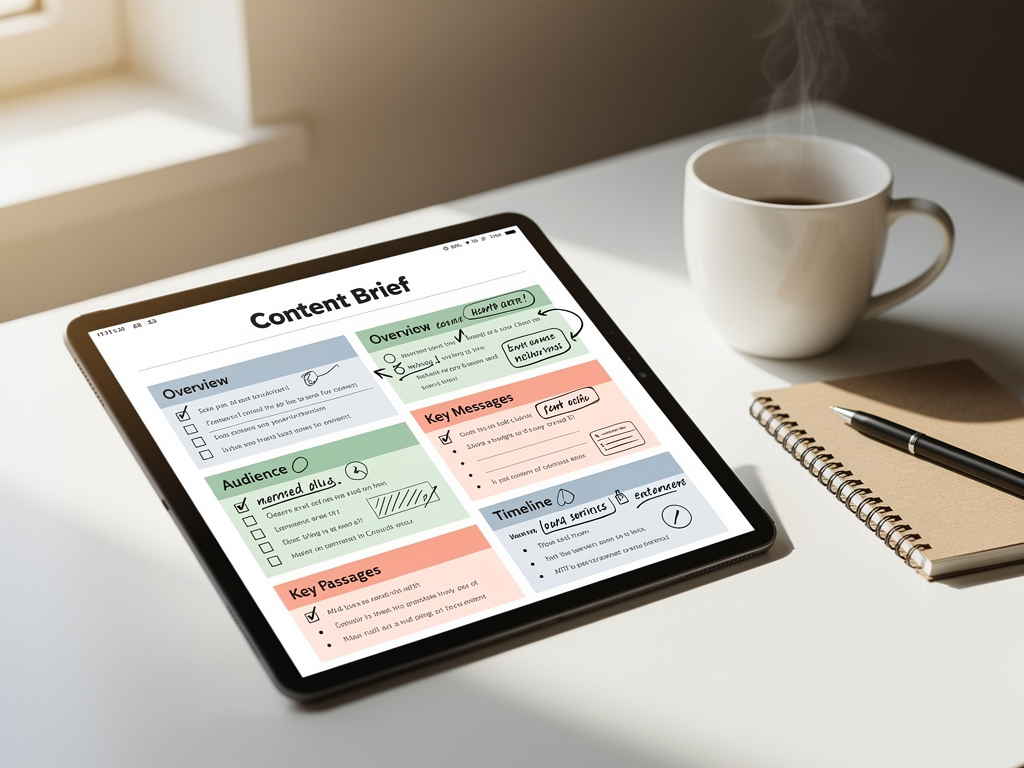
The fifth element is FAQ schema mapping. Your brief should list five to eight specific questions that will be formatted with FAQ schema markup. These questions should directly mirror queries appearing in AI chat interfaces. The answers must be concise, typically 50 to 150 words, and provide complete responses without requiring users to read additional content.
The sixth element involves entity specifications. List every brand, product, person, or concept that must be mentioned and specify exactly how each should be described. Consistency matters enormously for AI entity graphs. If your brief mentions a competitor, specify whether to use their full company name, common abbreviation, or product name.
The seventh element is internal linking targets. Specify three to five internal pages that should receive links, along with preferred anchor text variations. This supports topical authority signals that both Google and AI engines use to evaluate expertise. Platforms like SeoSmart automate internal linking based on your content sitemap, ensuring consistency across your publishing schedule.
The eighth element is source requirements. List authoritative external sources that should be cited, including industry reports, academic research, and recognized experts. AI engines evaluate the quality of sources you reference when determining your content's trustworthiness.
Structuring Content for AI Citation
The structural approach that earns AI citations differs significantly from traditional SEO content formatting. The core principle is front-loading value rather than building toward conclusions. Every major section should begin with its most citable insight, then expand with supporting detail, examples, and context.
Consider how AI engines process your content. They do not read linearly like humans. They identify passages that directly answer specific queries, evaluate those passages for factual accuracy and completeness, then determine whether to cite your source. Passages buried in the middle of long paragraphs rarely get extracted. Passages that begin sections with clear, direct statements get cited frequently.
Implement the inverted pyramid structure at both article and section levels. Your article should answer its primary question within the first 200 words. Each H2 section should answer its specific sub-question within the first sentence or two. Supporting details, examples, and elaboration follow. This structure serves both AI extraction and human readers who scan content before deciding to read deeply.
Use definition formatting consistently throughout your content. When introducing any concept, product, or methodology, provide a clear one to two sentence definition. Format these definitions consistently, either as the opening of a paragraph or set apart with bold text. AI engines learn to recognize and extract these definition patterns.
| Content Element | Traditional Approach | AI-Optimized Approach |
|---|---|---|
| Opening paragraph | Hook and narrative setup | Direct definition and primary answer |
| Section structure | Build toward conclusion | Lead with insight, then elaborate |
| Data presentation | Embedded in paragraphs | Tables and structured lists |
| Questions and answers | Implied through content | Explicit FAQ sections with schema |
| Source citations | Occasional references | Systematic attribution with links |
Implement passage isolation for your most valuable insights. When you have a statistic, process step, or factual claim that could answer a common query, format it as a standalone paragraph of 40 to 80 words. Do not bury it within a longer paragraph discussing multiple topics. AI engines extract isolated passages more readily than embedded claims.
Create comparison tables for any content involving multiple options, features, or approaches. Tables communicate structured information that AI engines parse efficiently. A table comparing five email marketing platforms with columns for pricing, key features, and ideal use cases provides more citation value than the same information spread across five paragraphs.
The 70/30 AI Production Model
The most effective content teams in 2026 operate on a 70/30 model where AI handles approximately 70% of production tasks while humans contribute the remaining 30% that requires judgment, expertise, and brand voice. Understanding which tasks belong in each category prevents both underutilization and overreliance on AI tools.
AI excels at research compression. Tasks that once required hours of reading competitor content, extracting key points, and synthesizing information now take minutes. Use AI to analyze the top ten ranking pages for your target query, identify common topics and subtopics, and generate a comprehensive outline. This research phase that previously consumed 30% of content production time now takes 5%.
AI handles first draft generation efficiently when given proper briefs. Using the AEO-ready brief framework, AI can produce 80% complete drafts that include proper structure, defined concepts, comparison tables, and FAQ sections. These drafts require human editing but provide a substantial foundation that accelerates production.
AI performs well at variant generation for testing and personalization. Need five different meta description options? Ten headline variations? Three different opening hooks for A/B testing? AI generates these variants in seconds, allowing human editors to select the best options rather than creating each from scratch.
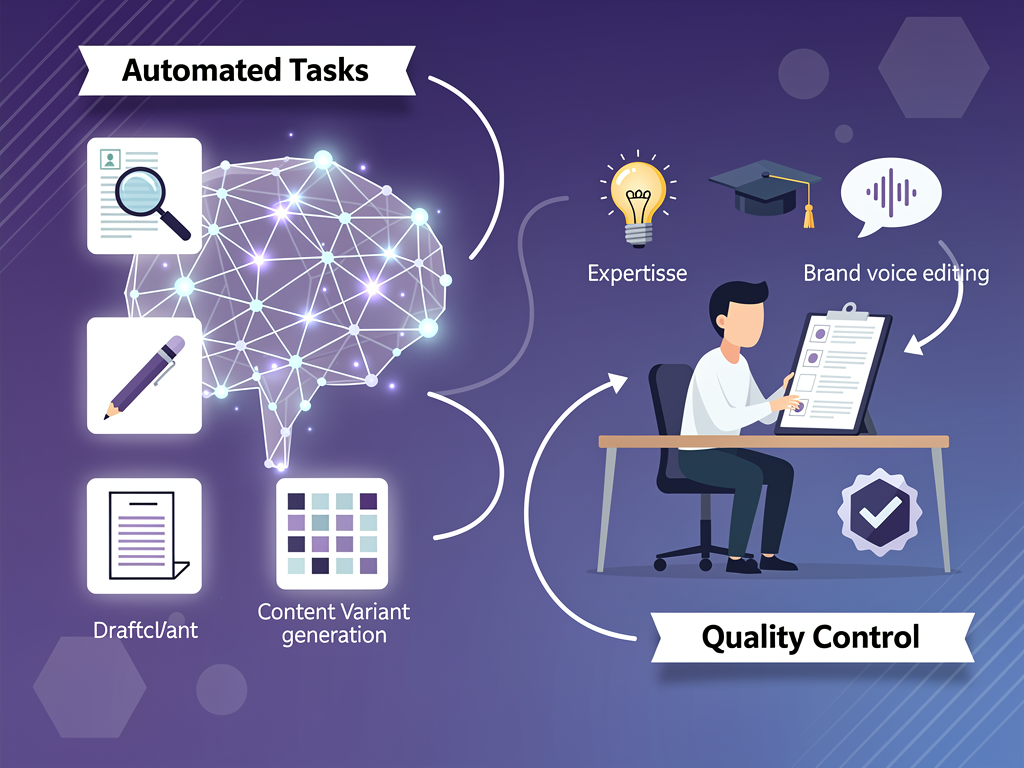
However, humans must handle expertise injection. AI cannot provide genuine insights from your company's experience, original research, or proprietary data. The 30% human contribution should focus on adding unique perspectives, case study details, and expert opinions that differentiate your content from competitors using the same AI tools.
Humans remain essential for brand voice calibration. AI can approximate your brand voice with proper prompting, but subtle tonal elements, humor, and cultural references require human judgment. Edit AI drafts to ensure they sound authentically like your brand rather than generically professional.
The most critical human contribution involves factual verification. AI models can generate plausible-sounding but incorrect information. Every statistic, claim, and procedural step must be verified by humans before publication. This verification step protects your brand reputation and ensures you are not cited by AI engines for inaccurate information.
Schema Markup as Architectural Foundation
Schema markup has evolved from an optional SEO enhancement to an architectural necessity. In 2026, AI engines use schema to understand content structure, identify key entities, and determine citation appropriateness. Sites without comprehensive schema implementation are effectively invisible to portions of the AI discovery ecosystem.
Implement Article schema on every blog post and content page. This schema should include author information with links to author pages, publication and modification dates, headline, description, and image references. Article schema helps AI engines understand your content's recency and authorship, both factors in citation decisions.
Deploy FAQPage schema on any page containing question-and-answer content. This schema directly feeds AI systems seeking answers to specific queries. When your FAQ schema matches a user's question, your answer becomes a primary candidate for citation. Ensure your FAQ schema answers are complete and self-contained.
Use HowTo schema for any procedural content. Step-by-step guides, tutorials, and process explanations benefit enormously from HowTo markup. AI engines frequently cite HowTo content when users ask how to accomplish specific tasks. Each step should be clearly defined with text descriptions and optional images.
Implement Product schema for e-commerce content and product reviews. This schema helps AI engines understand product attributes, pricing, and availability. When users ask AI assistants about product recommendations, properly marked-up product content earns citations more frequently than unstructured reviews.
Consider Organization schema for your about pages and homepage. This schema establishes your brand entity in AI knowledge graphs. Include your official name, logo, social profiles, contact information, and founding date. Consistent organization schema across your site reinforces entity clarity.
Implementation Tip: Platforms like SeoSmart include automated schema markup generation that applies appropriate schema types based on content structure, eliminating manual implementation for each piece of content.
Building Entity Authority Across the Web
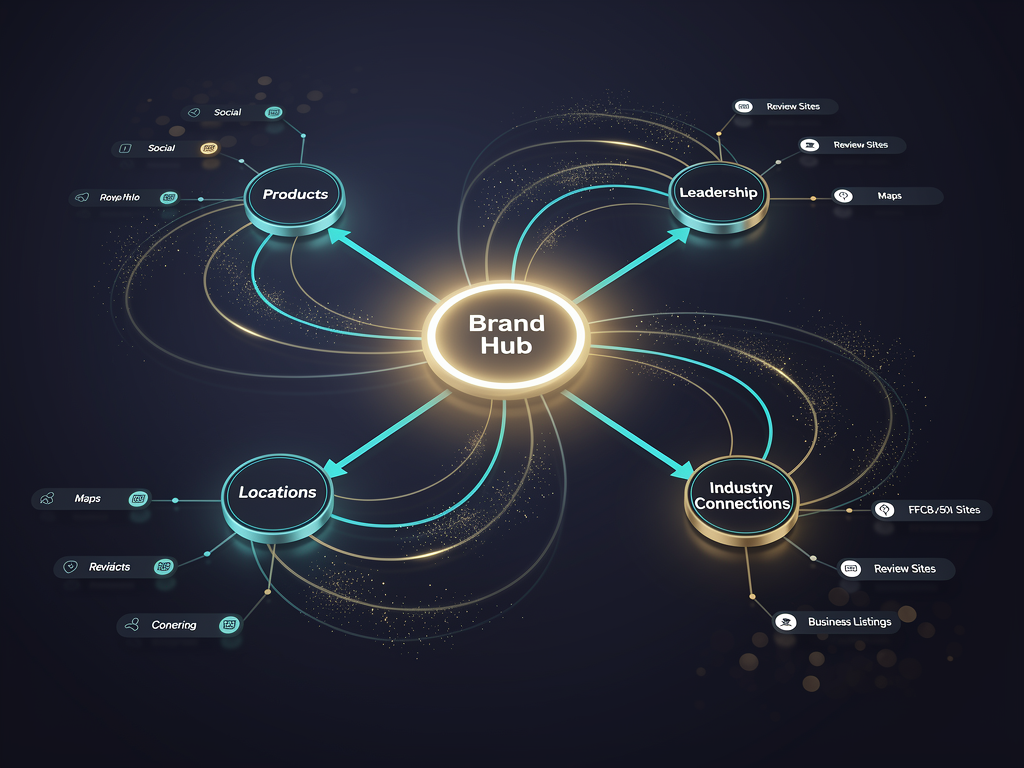
AI engines construct entity graphs before making citation decisions. An entity graph is a structured representation of your brand, its relationships to other entities, and the claims made about it across the web. Inconsistent or contradictory information weakens your entity graph and reduces citation likelihood.
Begin with an entity audit of your brand presence. Search for your brand name across Google, AI chat interfaces, Wikipedia, industry directories, and social platforms. Document how your brand is described in each location. Identify inconsistencies in company descriptions, founding dates, leadership names, product descriptions, and service offerings.
Create a canonical entity description that serves as your authoritative brand definition. This description should include your official company name, what you do in one sentence, your primary products or services, your founding year, and your headquarters location. Use this exact description consistently across all platforms you control.
Update your Google Business Profile with complete, accurate information matching your canonical description. Ensure your website's about page uses identical language. Update LinkedIn company pages, industry directory listings, and any other platforms where your brand appears. Consistency across these touchpoints strengthens your entity graph.
Pursue authoritative mentions that reinforce your entity. Industry publications, podcast appearances, conference speaking engagements, and guest posts on recognized sites all contribute to your entity authority. When these mentions use consistent descriptions of your brand, AI engines gain confidence in your entity graph.
Monitor for entity confusion with similarly named brands or products. If another company shares part of your name, AI engines may conflate your entities. Address this through distinctive branding, consistent use of your full company name, and content that clearly distinguishes your offerings from potential confusion sources.
Measuring AI Visibility and Citation Performance
Traditional SEO metrics remain important but insufficient for 2026. You need additional measurement frameworks that capture your performance in AI answer surfaces. Without these metrics, you cannot identify what is working, what needs improvement, or how you compare to competitors.
Track AI share of voice across your primary keyword clusters. This metric measures how frequently your brand appears in AI-generated answers relative to competitors. Monitor this weekly across ChatGPT, Google AI Overviews, Perplexity, and Gemini. Tools are emerging to automate this tracking, but manual sampling remains valuable for understanding citation context.
Measure branded search lift as an indicator of AI visibility impact. When your content gets cited in AI answers, users often search for your brand name directly afterward. Track branded search volume weekly and correlate increases with content publication and observed AI citations. A consistent pattern of branded search growth following AI citations validates your strategy.
Monitor citation quality beyond mere presence. Are AI engines citing your content accurately? Are they attributing claims correctly? Are they linking to appropriate pages? Poor quality citations can misrepresent your brand or direct users to outdated content. Regular auditing of how AI engines present your content identifies issues requiring attention.
| Metric | What It Measures | Target Frequency | Action Threshold |
|---|---|---|---|
| AI Share of Voice | Brand mentions in AI answers vs competitors | Weekly | Below 15% of category queries |
| Branded Search Lift | Increase in brand name searches | Weekly | No growth over 4 weeks |
| Citation Accuracy | Correct attribution of claims | Monthly | Any significant misrepresentation |
| Indexation Velocity | Time from publish to index | Per article | Over 48 hours consistently |
| Traditional Rankings | SERP positions for target keywords | Weekly | Position drops without traffic explanation |
Track indexation velocity for new content. In 2026, the window between publication and citation opportunity has compressed dramatically. Content that takes weeks to index misses citation opportunities that faster competitors capture. Monitor how quickly Google indexes your new content and address technical issues that slow indexation.
Continue tracking traditional metrics including organic traffic, keyword rankings, click-through rates, and engagement metrics. These remain important indicators of overall content health. However, interpret them in context of AI visibility. Traffic may decline for queries where AI Overviews appear even as your content earns citations and builds brand awareness.
Automating Your Content Production Pipeline
Scale requires automation, but effective automation requires careful workflow design. The teams producing high-quality content at volume have built pipelines that automate repetitive tasks while preserving human oversight at critical decision points.
Automate content planning and ideation using AI-powered tools that analyze your niche, identify content gaps, and suggest topics based on search demand and competitive opportunity. Manual topic ideation cannot keep pace with the volume requirements of modern content strategies. SeoSmart's AI content plan generator creates 30-day publishing calendars that account for topic deduplication and strategic keyword targeting.
Build automated brief generation into your workflow. Once topics are approved, AI can generate comprehensive briefs following your AEO-ready framework. These briefs should include question clusters, structural requirements, internal linking targets, and source specifications. Human review ensures briefs align with business objectives before production begins.
Implement draft generation automation that produces first drafts from approved briefs. These drafts should follow your structural templates, include proper heading hierarchy, and incorporate required elements like comparison tables and FAQ sections. Quality varies, so build in human editing as a mandatory step before publication.
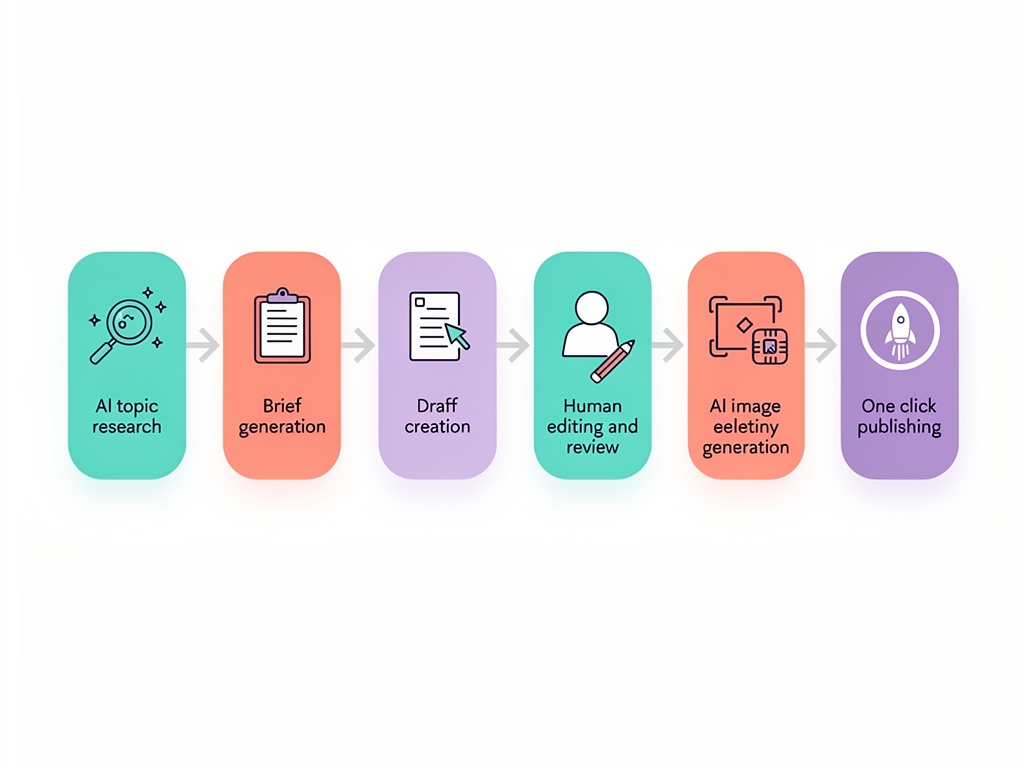
Automate image generation for article illustrations. AI image generation has matured significantly, producing professional visuals that enhance content without requiring graphic design resources. Specify image requirements in your briefs, including subject matter, style, and composition. Platforms that integrate image generation with content production eliminate manual handoffs between writing and design.
Set up automated publishing to your CMS. Manual copy-paste from document editors to WordPress, Webflow, or Shopify introduces errors and consumes time. Direct integrations that push formatted content with images, internal links, and schema markup to your CMS eliminate this friction. SeoSmart offers one-click publishing to major CMS platforms, including automatic scheduling for optimal posting times.
Build backlink automation into your distribution workflow. Quality backlinks remain important for both traditional rankings and AI entity authority. Backlink exchange networks and automated outreach tools can supplement manual link building efforts. Ensure any automated link building maintains quality standards that protect your site from algorithmic penalties.
Avoiding Common AI Content Pitfalls
The accessibility of AI writing tools has created new categories of content mistakes. Understanding these pitfalls helps you avoid the errors that undermine both rankings and citations.
The most damaging pitfall is publishing unedited AI output. Raw AI-generated content often contains factual errors, awkward phrasing, and generic insights that add no value. Google's spam policies explicitly target content created primarily to manipulate rankings without providing value to users. AI-generated content farms have been deindexed entirely. Every piece of AI-assisted content requires human editing, fact-checking, and value addition.
Avoid over-optimization for AI extraction at the expense of readability. Some teams have swung too far toward mechanical, passage-optimized content that reads like a database rather than helpful information. Content must serve human readers first. If your content earns citations but drives visitors away with poor reading experience, you have failed at the fundamental goal of content marketing.
Watch for entity inconsistency introduced by AI tools. When using AI to generate content about your products, services, or brand, the AI may introduce variations in how entities are described. A single article that refers to your product as "ContentPro," "Content Pro," and "the ContentPro platform" creates entity confusion. Establish entity naming conventions and enforce them during editing.
Beware of citation fabrication by AI models. AI tools sometimes generate plausible-sounding citations to sources that do not exist or do not say what the AI claims. Every external citation in AI-assisted content must be verified by clicking through to the source and confirming the claim. Publishing fabricated citations damages credibility with both readers and AI systems that may later identify the errors.
Avoid template fatigue from over-reliance on content formulas. When every article follows identical structure with the same section types in the same order, your content becomes predictable and undifferentiated. Use structural templates as starting points, then vary them based on topic requirements. Some topics need more comparison tables; others need more procedural steps. Let content needs drive structure rather than forcing all topics into identical formats.
Industry-Specific Application Strategies
Different industries and business models require adapted approaches to AI-optimized content. Understanding how these principles apply to your specific context improves implementation effectiveness.
For B2B SaaS companies, focus on comparison content and integration guides. B2B buyers frequently ask AI assistants to compare software options or explain how tools work together. Create comprehensive comparison pages with detailed feature tables, pricing breakdowns, and use case recommendations. Integration documentation with clear procedural steps earns citations when users ask how to connect your product with other tools in their stack.
For e-commerce stores, prioritize buying guides and product category content. AI shopping assistants are emerging as significant traffic drivers. Create category pages that answer questions like "best running shoes for flat feet" with specific product recommendations, comparison tables, and clear reasoning for each recommendation. Include Product schema on all product pages and Review schema on review content.
For affiliate marketers and niche site builders, differentiate through original research and testing. AI engines can access the same product specifications and manufacturer claims as everyone else. Your competitive advantage comes from original testing, real-world usage insights, and specific recommendations based on experience. Document your testing methodology and results in formats AI engines can extract and cite.
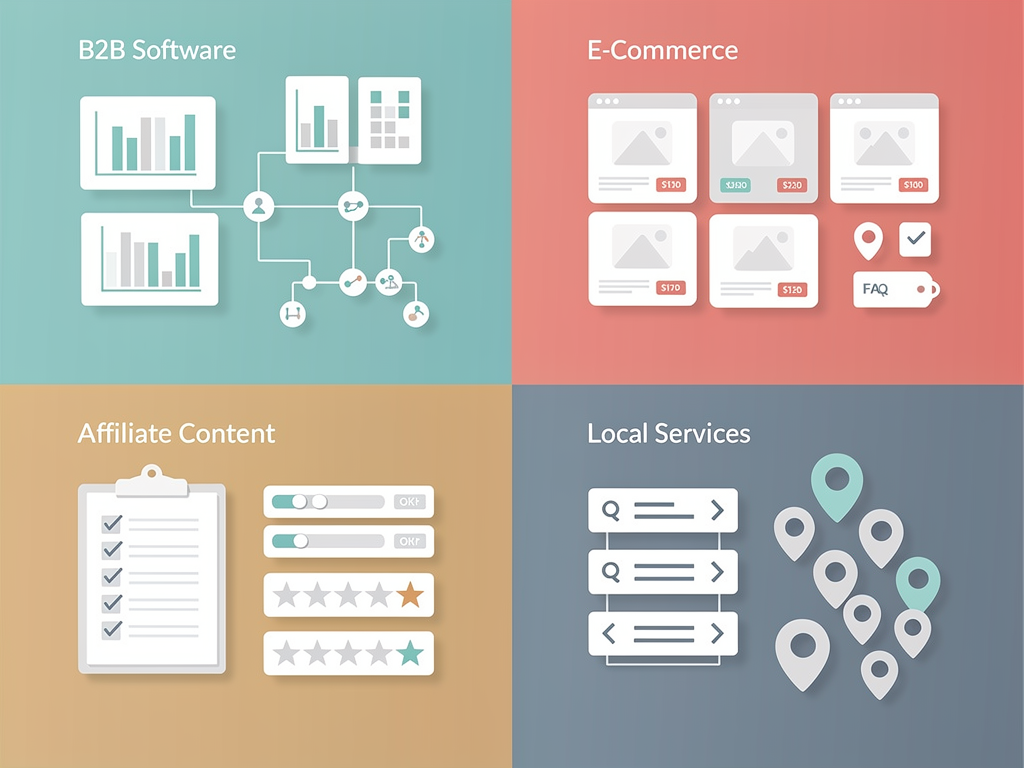
For local service businesses, emphasize location-specific content and FAQ coverage. Users asking AI assistants about local services want specific answers about service areas, pricing, and availability. Create location pages with detailed service descriptions, FAQ sections addressing common questions, and clear contact information. LocalBusiness schema helps AI engines understand your service area and offerings.
For content agencies serving multiple clients, build scalable processes that adapt to client industries. Develop industry-specific brief templates, schema configurations, and structural approaches. Train team members on industry nuances that affect content strategy. The 70/30 model scales well across clients when the 30% human contribution includes industry expertise.
Building Topical Authority Through Content Clusters
Publishing isolated articles on random topics no longer builds meaningful authority. AI engines evaluate topical depth when determining citation worthiness. Sites that demonstrate comprehensive coverage of a subject area earn more citations than sites with scattered, superficial coverage.
Design content clusters around your core topics. Each cluster should include a comprehensive pillar page covering the topic broadly, plus eight to fifteen supporting articles addressing specific subtopics, questions, and use cases. Internal links should connect supporting articles to the pillar and to each other, creating a web of related content that signals topical authority.
Map your clusters to user journey stages. Awareness-stage content should answer basic questions and define concepts. Consideration-stage content should compare options and explain approaches. Decision-stage content should provide specific recommendations and implementation guidance. This journey mapping ensures your cluster serves users at every stage while building comprehensive topical coverage.
Implement hub-and-spoke internal linking within each cluster. The pillar page serves as the hub, linking out to all supporting articles. Each supporting article links back to the pillar and to two or three related supporting articles. This linking structure helps both search engines and AI systems understand the relationships between your content pieces.
Update clusters systematically rather than randomly. When industry changes affect your topic area, update the pillar page first, then cascade updates to affected supporting articles. This systematic approach maintains consistency across your cluster and signals to AI engines that your content reflects current information.
Measure cluster performance as a unit, not just individual articles. Track total traffic, citations, and conversions for the entire cluster. A supporting article with low individual traffic may still contribute significantly to cluster authority and pillar page performance. Evaluate whether to expand, consolidate, or retire clusters based on collective metrics.
Future-Proofing Your Content Strategy
The search landscape will continue evolving. The strategies that work in 2026 will require adaptation as AI capabilities expand and user behaviors shift. Building adaptability into your content strategy protects your investment against future changes.
Invest in content infrastructure that supports rapid iteration. Your CMS, publishing workflows, and content management systems should allow quick updates across multiple pages. When AI engines change how they extract and cite content, you need the ability to update structural elements across your entire content library efficiently.
Build first-party data assets that AI cannot replicate. Original research, proprietary datasets, customer surveys, and case studies provide unique value that differentiates your content from competitors using the same AI tools and public information sources. These assets become increasingly valuable as AI-generated content commoditizes basic information.
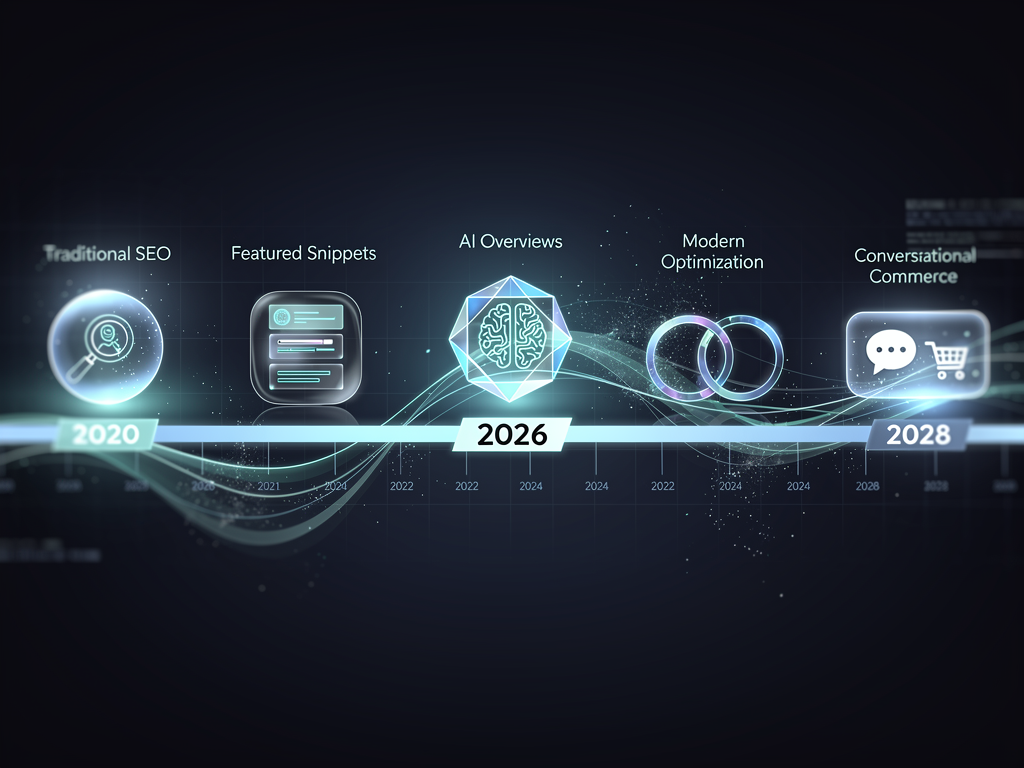
Develop multi-surface distribution capabilities. Content that performs well in traditional search, AI chat interfaces, social platforms, and email can weather changes in any single channel. Repurpose your core content for different formats and platforms, adapting structure and presentation while maintaining consistent messaging and entity descriptions.
Maintain human expertise as your irreplaceable asset. AI tools will continue improving at research, drafting, and optimization tasks. Human judgment, creativity, and expertise become more valuable as AI handles more routine work. Invest in developing team expertise in your subject areas rather than just AI tool proficiency.
Stay informed about AI search developments through industry publications, conference presentations, and direct experimentation. The teams that adapt fastest to changes gain competitive advantages during transition periods. Build learning and experimentation into your regular workflow rather than treating it as an occasional activity.
Implementation Roadmap for Teams
Transforming your content strategy requires systematic implementation rather than attempting everything simultaneously. This roadmap provides a phased approach that builds capabilities progressively while generating results at each stage.
Phase One (Weeks 1-4): Foundation
- Audit current content for structural gaps and entity inconsistencies
- Implement basic schema markup (Article, FAQPage) on existing high-value content
- Establish entity naming conventions and canonical brand descriptions
- Set up AI visibility monitoring for your primary keyword clusters
- Select and configure AI writing tools for your workflow
Phase Two (Weeks 5-8): Process Development
- Create AEO-ready brief templates customized for your industry
- Train team members on the 70/30 production model
- Build content cluster maps for your three to five core topics
- Establish editing checklists that include AI optimization elements
- Implement automated publishing workflows to your CMS
Phase Three (Weeks 9-12): Scale and Optimize
- Increase content production volume using automated pipelines
- Expand schema implementation to include HowTo, Product, and Organization types
- Launch systematic content cluster development
- Refine processes based on performance data and team feedback
- Begin backlink building focused on entity authority reinforcement

Phase Four (Ongoing): Continuous Improvement
- Weekly AI visibility monitoring and competitive analysis
- Monthly content audits and update cycles
- Quarterly strategy reviews based on performance trends
- Ongoing team training as AI tools and search algorithms evolve
- Regular experimentation with new content formats and optimization approaches
Adjust timeline based on your team size and current capabilities. Smaller teams may need longer phases; larger teams with existing content operations may compress the timeline. The key is maintaining systematic progress rather than rushing implementation and creating quality issues.
Tools and Platforms Supporting AI Content Optimization
The tool landscape for AI content optimization has matured significantly. Understanding the categories of tools available helps you build an effective technology stack without redundant investments.
All-in-one content platforms combine multiple capabilities into unified workflows. SeoSmart exemplifies this category, offering AI article generation, keyword research, image creation, schema markup, and automated publishing in a single platform. These platforms reduce tool fragmentation and workflow complexity, particularly valuable for smaller teams or agencies managing multiple clients.
AI writing assistants like ChatGPT, Claude, and Gemini provide flexible content generation capabilities. These tools excel at research compression, draft generation, and variant creation. However, they require more manual workflow management and do not include publishing automation or SEO-specific features without additional tools.
SEO content optimization tools including Surfer, Clearscope, Frase, and MarketMuse analyze top-ranking content and provide optimization recommendations. These tools help ensure your content covers topics comprehensively and uses appropriate terminology. They complement AI writing tools but focus on optimization rather than generation.
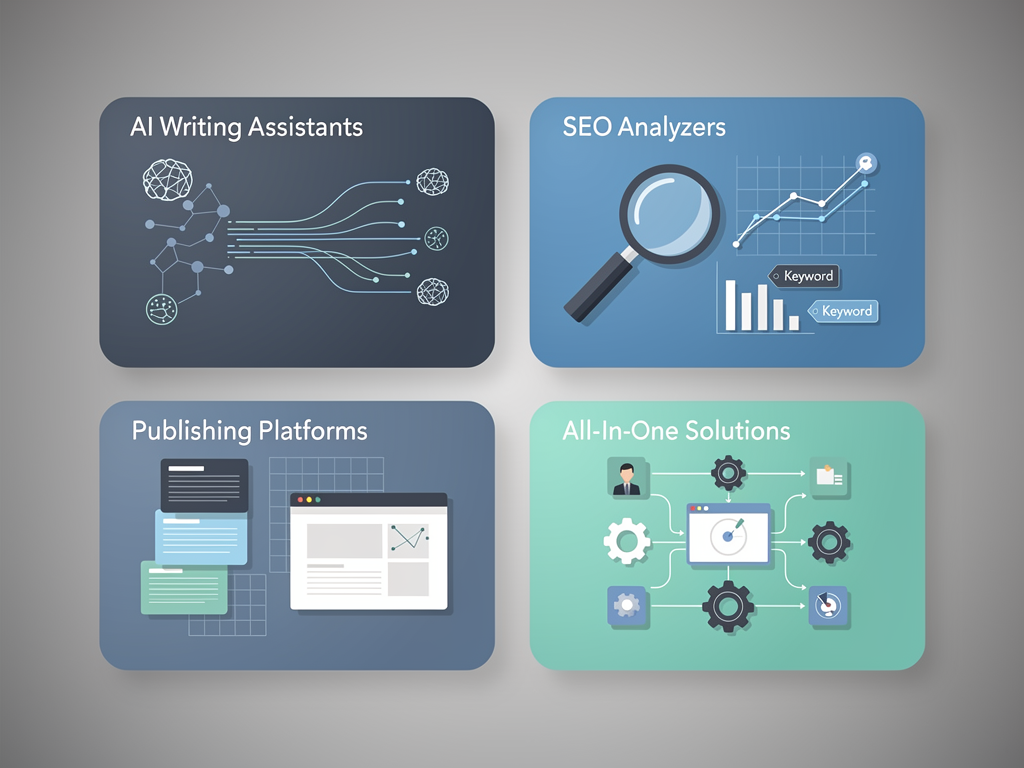
Schema generation tools help implement structured data without manual coding. Some are standalone tools; others integrate with CMS platforms or content generation systems. Evaluate whether your chosen content platform includes schema capabilities before adding separate tools.
AI visibility monitoring tools track your brand presence across AI search surfaces. This emerging category helps measure the metrics discussed earlier, including AI share of voice and citation quality. As this category matures, expect more sophisticated competitive analysis and alerting capabilities.
Publishing automation tools connect content creation to CMS platforms. These range from simple integrations to sophisticated systems that handle formatting, image placement, internal linking, and scheduling. Evaluate your current publishing friction to determine how much automation provides meaningful time savings.
Conclusion
The 2026 content landscape demands a fundamental shift in how we approach creation, optimization, and distribution. Success requires serving two audiences simultaneously: human readers who consume your content and AI engines that decide whether to cite it. The teams thriving today have embraced this duality, building workflows that produce structurally optimized content at scale while maintaining the quality and expertise that earn both rankings and citations.
The strategies outlined in this playbook are not theoretical possibilities but proven approaches used by agencies and in-house teams generating measurable results. The AEO-ready brief framework ensures every piece of content starts with citation potential built in. The 70/30 production model balances AI efficiency with human expertise. Schema implementation transforms your content into machine-readable assets that AI engines can confidently cite.
Implementation requires commitment but not perfection. Start with the foundation phase, building basic capabilities and establishing processes. Expand systematically as your team develops proficiency. Measure both traditional metrics and AI visibility indicators to understand your true performance across the dual search ecosystem.
The brands that will dominate their categories over the next several years are making these investments now. They understand that the window for establishing AI visibility leadership is open but narrowing. As more organizations adopt these approaches, the competitive advantage shifts from early adoption to superior execution. The time to transform your content strategy is not next quarter or next year. It is now.

Frequently Asked Questions
How long does it take to see results from AI-optimized content strategies?
Results from AI-optimized content strategies typically emerge in two phases with different timelines. Traditional ranking improvements follow familiar patterns, with initial movement visible within four to eight weeks and significant ranking changes occurring over three to six months depending on competition levels and domain authority. AI citation results can appear faster, sometimes within days of publication for well-structured content targeting queries where AI Overviews appear. However, building consistent AI visibility across a topic cluster requires sustained effort over several months. Teams implementing the full playbook typically see measurable AI share of voice improvements within 60 to 90 days, with compounding effects as content clusters mature and entity authority strengthens. The key is measuring both surfaces from the beginning so you can identify which elements of your strategy are working and optimize accordingly.
Does AI-generated content risk penalties from Google?
Google's spam policies target content created primarily to manipulate rankings without providing value to users, regardless of how that content was created. AI-assisted content that provides genuine value, demonstrates expertise, and serves user needs does not violate these policies. The risk comes from publishing unedited AI output that lacks accuracy, originality, or usefulness. The 70/30 model specifically addresses this risk by ensuring human expertise, fact-checking, and value addition in every piece of content. Teams that use AI for research compression and draft generation while adding genuine insights, verifying facts, and editing for quality operate well within Google's guidelines. The content farms that have been deindexed were publishing thousands of low-quality pages with minimal human oversight. Responsible AI-assisted content production with proper editorial processes poses no meaningful penalty risk.
What is the minimum content volume needed to build topical authority?
Topical authority requires depth rather than arbitrary volume targets. For most topics, a well-structured content cluster needs one comprehensive pillar page of 3,000 to 5,000 words plus eight to fifteen supporting articles of 1,500 to 3,000 words each. This provides sufficient coverage to demonstrate expertise while maintaining quality standards. However, competitive topics may require larger clusters, while niche topics with limited subtopics may need fewer pieces. The key indicators of sufficient coverage include ranking for long-tail variations of your target keywords, earning featured snippets for specific questions within your topic, and receiving AI citations that reference multiple pieces within your cluster. Start with the minimum viable cluster, measure performance, and expand based on competitive gaps and user question coverage. Quality always trumps quantity, and a smaller cluster of excellent content outperforms a larger cluster of mediocre pieces.
How do I prioritize which existing content to optimize for AI citations?
Prioritize existing content based on three factors: current performance, citation potential, and business value. Start with pages that already rank on page one for queries where AI Overviews appear, as these have proven relevance and need only structural optimization to earn citations. Next, prioritize content targeting questions that AI assistants frequently answer, identifiable through manual testing in ChatGPT, Perplexity, and Google AI Overviews. Finally, weight business value by focusing on content targeting high-intent keywords that drive conversions. Create a scoring matrix combining these factors to rank your content library. Begin optimization with your top ten pages, implementing structural improvements, adding FAQ sections with schema, and creating comparison tables where appropriate. Measure citation improvements before expanding to the next tier. This systematic approach maximizes impact while building team proficiency in optimization techniques.
Can small businesses compete with larger companies for AI citations?
Small businesses can absolutely compete for AI citations, often more effectively than larger competitors in specific niches. AI engines prioritize content quality, structural clarity, and topical relevance over domain authority or brand recognition. A small business with deep expertise in a narrow topic can build comprehensive content clusters that outperform superficial coverage from larger competitors. The key advantages for small businesses include agility in implementing new strategies, ability to focus resources on specific topic areas, and authentic expertise that larger competitors may lack. Focus on topics where you have genuine expertise and can provide insights unavailable elsewhere. Build tight content clusters around your specialty areas rather than attempting broad coverage. Implement schema markup consistently, which many larger competitors neglect. The playing field for AI citations rewards quality and structure over size, creating genuine opportunities for focused small businesses to capture visibility in their niches.
How often should content be updated to maintain AI citation eligibility?
Content update frequency depends on topic volatility and competitive dynamics. Evergreen topics with stable information may need updates only annually to refresh statistics and add new developments. Fast-moving topics like technology, regulations, or market trends may require quarterly or even monthly updates to maintain accuracy. AI engines evaluate content freshness through publication dates, modification dates, and the currency of referenced information. Establish a content audit calendar that reviews your highest-value pages monthly, checking for outdated statistics, broken links, and competitive gaps. When competitors publish superior content on your target topics, prioritize updates to maintain or regain citation eligibility. Use modification date schema to signal updates to AI engines. The goal is not constant revision but strategic maintenance that keeps your content accurate and competitive. Automated monitoring tools can alert you when AI citations shift to competitors, triggering targeted update efforts.
Ready to Transform Your Content Strategy?
Implementing the strategies in this playbook requires the right tools and workflows. SeoSmart provides everything you need to create AI-optimized content at scale: intelligent keyword research, automated content planning, AI-powered article generation with proper structure and schema, image creation, and one-click publishing to your CMS. Start with 500 free credits and experience how automated content sprints can transform your organic visibility across both traditional search and AI answer surfaces. Join the teams already ranking higher and earning more citations with AI-powered content production.
Subscribe to our newsletter
Subscribe to our newsletter and stay up-to-date with the latest news and updates.