How AI Automation is Transforming SEO & Content Marketing
Discover how AI-powered automation is revolutionizing SEO by streamlining content creation, optimization, and distribution. Learn how intelligent systems offer new opportunities for marketers, enabling efficient keyword research and real-time optimization.

Zakariae

The search engine optimization landscape has undergone a seismic shift in recent years, with artificial intelligence emerging as the driving force behind unprecedented changes in how content is created, optimized, and distributed. For digital marketing professionals, content managers, and business owners alike, understanding this transformation is no longer optional but essential for maintaining competitive visibility in an increasingly crowded online marketplace. The emergence of intelligent automation systems has fundamentally altered the relationship between marketers and search engines, creating new opportunities for those willing to embrace these technological advances while posing significant challenges for those who cling to outdated methodologies.
Key Takeaways
AI-powered automation systems can now handle complex SEO tasks that previously required extensive manual effort, from keyword research to content optimization and technical audits.
Modern content marketing platforms leverage machine learning to generate brand-tailored articles at scale while maintaining quality and search engine compliance.
Backlink acquisition has been revolutionized through automated exchange networks that build domain authority without the traditional outreach burden.
Real-time optimization capabilities allow businesses to respond to algorithm changes and trending topics faster than ever before.
Integration with existing CMS platforms enables seamless publishing workflows that eliminate manual content transfer processes.
Cost efficiency improvements of 60-80% are achievable when implementing AI-driven content strategies compared to traditional agency models.
Multilingual content generation opens global markets without the expense of human translation services for each target language.

Modern SEO professionals leverage AI-powered dashboards to monitor and optimize content performance across multiple channels simultaneously.
Understanding the Evolution of Search Engine Optimization Automation
The journey from manual SEO practices to intelligent automation represents one of the most significant transformations in digital marketing history. In the early days of search optimization, practitioners spent countless hours manually researching keywords using basic tools, crafting individual meta descriptions, and building backlinks through laborious outreach campaigns. This approach, while effective for its time, simply cannot scale to meet the demands of modern content marketing where businesses must produce dozens or even hundreds of pieces of optimized content monthly to maintain visibility.
The introduction of machine learning algorithms into SEO workflows marked the beginning of a new era. These systems could analyze vast datasets of search queries, identify patterns in ranking factors, and predict which content strategies would yield the best results. According to Salesforce's comprehensive AI for SEO guide, artificial intelligence enables marketers to analyze vast amounts of data with unprecedented speed and accuracy, fundamentally changing how optimization decisions are made.
What distinguishes contemporary AI-driven SEO from earlier automation attempts is the sophistication of natural language processing capabilities. Modern systems understand context, semantic relationships, and user intent in ways that were impossible just five years ago. This understanding allows them to generate content that genuinely addresses search queries rather than simply stuffing keywords into templated formats. The result is content that satisfies both algorithmic requirements and human readers, a combination that proves essential for sustainable ranking success.
The democratization of these technologies has leveled the playing field between large enterprises with substantial marketing budgets and smaller businesses seeking to compete for valuable search real estate. Where previously only major corporations could afford teams of SEO specialists and content writers, automated platforms now enable small business owners and solo entrepreneurs to implement sophisticated optimization strategies at a fraction of the traditional cost.
The Anatomy of Modern AI-Powered Content Systems
Contemporary AI content platforms operate through a complex interplay of multiple specialized components, each handling distinct aspects of the content creation and optimization process. Understanding these components helps marketers make informed decisions about which solutions best fit their specific needs and workflows. The core architecture typically includes natural language generation engines, semantic analysis modules, competitive intelligence systems, and publishing automation frameworks.
Natural language generation represents the heart of these systems, utilizing large language models trained on billions of text examples to produce human-quality writing. These models have evolved dramatically, with current iterations capable of maintaining consistent brand voice, incorporating specific terminology, and adapting tone for different audience segments. The most advanced platforms allow users to provide knowledge bases and style guidelines that shape output to match existing content libraries seamlessly.
Semantic analysis modules ensure that generated content addresses topics comprehensively rather than superficially. These systems analyze top-ranking content for target keywords, identify subtopics and related concepts that should be covered, and verify that the final output provides genuine value to readers. This comprehensive approach aligns with search engine preferences for authoritative, in-depth content over thin pages that barely scratch the surface of their subjects.
Expert Insight: The most successful AI content implementations combine automated generation with strategic human oversight. Platforms that allow for knowledge base integration and brand customization consistently outperform generic content mills that treat every client identically.
Competitive intelligence components continuously monitor search results, tracking ranking fluctuations, identifying content gaps, and spotting opportunities where competitors have failed to address user needs adequately. This real-time awareness enables proactive strategy adjustments rather than reactive responses to traffic declines. Businesses using these systems can identify trending topics and publish relevant content before competitors recognize the opportunity.
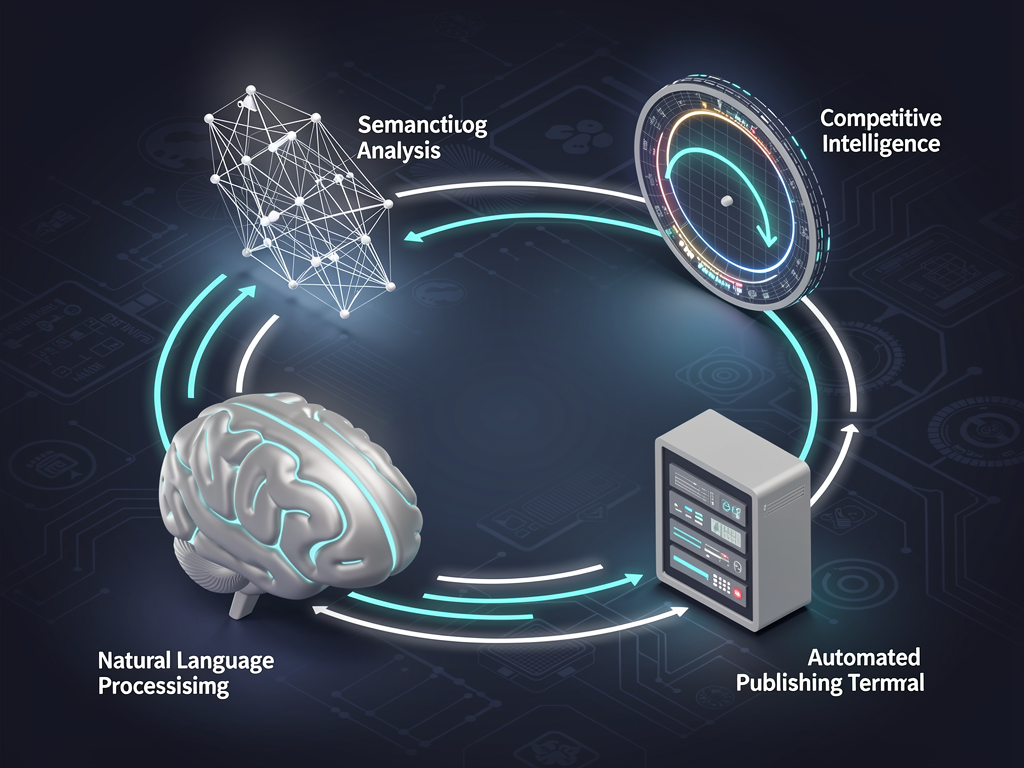
The architecture of modern AI content platforms integrates multiple specialized components working in concert to produce optimized content.
How Intelligent Systems Transform Keyword Research
Traditional keyword research involved hours of manual work sifting through spreadsheets, analyzing search volumes, and attempting to gauge competition levels through imprecise metrics. Modern AI-powered keyword research tools have transformed this process into a streamlined workflow that delivers actionable insights in minutes rather than days. These systems leverage machine learning to identify not just individual keywords but entire topic clusters that represent comprehensive content opportunities.
The sophistication of current keyword analysis extends far beyond simple volume and difficulty scores. Advanced platforms analyze search intent categorization, determining whether queries indicate informational, navigational, commercial, or transactional intent. This classification proves crucial for content strategy, as different intent types require fundamentally different content approaches. A user searching for "best email marketing software" has different needs than someone searching for "how does email marketing work," and AI systems recognize these distinctions automatically.
Semantic keyword grouping represents another significant advancement enabled by artificial intelligence. Rather than treating each keyword as an isolated target, modern systems identify relationships between terms and group them into logical clusters that can be addressed through comprehensive content pieces. This approach aligns perfectly with how search engines now evaluate content, rewarding pages that demonstrate topical authority across related concepts rather than those optimized for single keywords in isolation.
Predictive analytics capabilities allow these systems to identify emerging keyword opportunities before they become highly competitive. By analyzing search trend patterns, social media discussions, and news coverage, AI tools can forecast which topics will gain search volume in coming weeks or months. Businesses that act on these predictions gain first-mover advantages, establishing authority on topics before competitors recognize their potential value.
The integration of keyword research with content generation creates particularly powerful workflows. Platforms like SeoSmart's automated content platform combine AI-driven keyword analysis with article generation, ensuring that produced content targets validated opportunities rather than arbitrary topics. This integration eliminates the disconnect that often occurs when separate teams handle research and content creation, resulting in more strategically aligned output.
Content Generation at Scale: Quality Versus Quantity
The debate over AI-generated content quality has evolved significantly as the technology has matured. Early concerns about robotic, obviously automated text have given way to recognition that properly configured AI systems can produce content indistinguishable from human-written material. The key differentiator lies not in whether AI is used but in how it is implemented, configured, and supervised within content workflows.
Quality AI content generation requires substantial upfront investment in system configuration. This includes developing comprehensive knowledge bases that provide accurate information about the business, its products, and its industry. It also involves establishing clear brand voice guidelines, defining target audience characteristics, and specifying the types of examples and references that should appear in content. Platforms that skip these configuration steps produce generic output that fails to differentiate brands from competitors.
The scale advantages of AI content generation become apparent when examining production economics. A skilled human writer might produce two to three well-researched, optimized articles per day at maximum sustainable output. AI systems configured for the same quality standards can generate dozens of articles daily, each incorporating proper keyword optimization, internal linking, and multimedia elements. For businesses competing in content-intensive niches, this production capacity proves transformative.
Content Production Method | Articles Per Month | Average Cost Per Article | Time to Publish | Consistency Score |
|---|---|---|---|---|
Traditional Agency | 8-12 | $300-$500 | 5-7 days | Variable |
Freelance Writers | 12-20 | $150-$300 | 3-5 days | Inconsistent |
AI with Human Editing | 30-60 | $50-$100 | 1-2 days | High |
Fully Automated AI Platform | 60-120 | $20-$50 | Same day | Very High |
Content sprint models have emerged as a popular approach for businesses seeking rapid content library development. These programs commit to producing specific article quantities over defined periods, typically 30 or 60 articles per month, with automated scheduling and publishing. The consistency of output proves particularly valuable for SEO, as search engines favor websites that demonstrate regular publishing cadences over those with sporadic content updates.

Comparing traditional content workflows with AI-automated approaches reveals dramatic efficiency improvements in production timelines.
The Technical SEO Automation Revolution
Beyond content creation, AI systems have transformed technical SEO practices that historically required specialized expertise and manual implementation. Schema markup generation, once requiring detailed knowledge of structured data formats, now happens automatically as content is published. These markup additions help search engines understand content context, potentially qualifying pages for rich result features that dramatically improve click-through rates.
Automated technical auditing represents another area where AI has made significant inroads. Modern platforms continuously monitor websites for technical issues including broken links, slow-loading pages, mobile usability problems, and crawl errors. Rather than waiting for periodic manual audits, these systems identify issues in real-time and can often implement fixes automatically or alert appropriate team members immediately.
Internal linking optimization has historically been one of the most neglected aspects of SEO due to the manual effort required to maintain logical link structures across large content libraries. AI systems now analyze content relationships and automatically insert relevant internal links as new articles are published. This automation ensures that link equity flows appropriately throughout the site while helping users discover related content that addresses their broader information needs.
The automation of meta title and description generation deserves particular attention given its impact on click-through rates from search results. AI systems can generate multiple variations of these elements, test them against engagement metrics, and automatically implement winning versions. This continuous optimization approach yields incremental improvements that compound over time into significant traffic gains.
Image optimization, including alt text generation and file compression, has similarly benefited from AI automation. Platforms now generate descriptive, keyword-appropriate alt text automatically while ensuring images are properly sized and compressed for fast loading. These seemingly minor optimizations collectively contribute to improved page experience signals that search engines increasingly weight in ranking decisions.
Backlink Acquisition Through Automated Networks
Link building has traditionally been among the most challenging and time-consuming aspects of SEO, requiring extensive outreach, relationship building, and often significant financial investment. The emergence of automated backlink exchange networks has introduced a new paradigm that dramatically reduces the effort required to build domain authority while maintaining the quality standards that search engines demand.
These networks operate on principles of mutual benefit, connecting websites within related but non-competing niches for reciprocal linking arrangements. Unlike manipulative link schemes that search engines penalize, properly structured exchange networks create genuine editorial links within relevant content contexts. The key distinction lies in the natural integration of links within valuable content rather than artificial placement in link farms or unrelated pages.
The automation of link exchange management eliminates the administrative burden that previously made such programs impractical for smaller operations. Platforms handle partner matching, link placement verification, and ongoing monitoring to ensure that acquired links remain active and valuable. This hands-off approach allows marketers to benefit from link building without dedicating staff time to outreach and relationship management.
Quality controls within these networks have matured significantly, with sophisticated filtering ensuring that participating sites meet minimum standards for domain authority, content quality, and topical relevance. The best platforms also monitor for signs of spam or manipulation, removing problematic participants before they can negatively impact network members. This self-policing creates sustainable ecosystems that deliver long-term value rather than short-term gains followed by penalties.
The economics of automated link building prove compelling when compared to traditional approaches. Manual outreach campaigns typically yield response rates below 5%, meaning that acquiring a single quality backlink might require hundreds of personalized emails. Automated networks eliminate this inefficiency, providing predictable link acquisition at costs that make comprehensive link building accessible to businesses of all sizes.

Automated backlink exchange networks connect relevant websites for mutual authority building through natural link placements.
Multilingual Content Strategies Enabled by AI
Global market expansion has historically required substantial investment in translation services and localized content creation. AI-powered content platforms have fundamentally changed this equation, enabling businesses to produce native-quality content in over 150 languages without maintaining separate content teams for each target market. This capability opens international SEO opportunities that were previously accessible only to large enterprises with substantial localization budgets.
The quality of AI translation has improved dramatically beyond simple word-for-word conversion. Modern systems understand idiomatic expressions, cultural references, and regional terminology variations, producing content that reads naturally to native speakers. This linguistic sophistication proves essential for SEO, as search engines evaluate content quality based on language naturalness and user engagement metrics that suffer when translations feel awkward or mechanical.
Localization extends beyond language to encompass cultural adaptation of examples, references, and recommendations. AI systems can modify content to reflect local business practices, regulatory environments, and consumer preferences. An article about email marketing best practices might reference GDPR compliance for European audiences while emphasizing CAN-SPAM requirements for US readers, with these adaptations happening automatically based on target market specifications.
The SEO implications of multilingual content capability are substantial. Businesses can target long-tail keywords in languages where competition remains lower than in English-language markets. A niche product might face intense competition for English keywords while finding relatively open opportunities in German, Spanish, or Portuguese markets. AI content generation makes pursuing these opportunities economically viable rather than prohibitively expensive.
Regional search engine optimization also benefits from AI-driven localization. While Google dominates globally, markets like China, Russia, and South Korea have significant alternative search engines with different ranking factors and content preferences. AI systems can adapt content strategies for these platforms, ensuring that businesses maximize visibility across all relevant search ecosystems rather than optimizing solely for Google.
Integration With Content Management Systems
The practical value of AI content generation depends heavily on how seamlessly it integrates with existing publishing workflows. Leading platforms now offer direct connections to major content management systems including WordPress, Webflow, Shopify, and Ghost, enabling one-click publishing that eliminates manual content transfer processes. This integration transforms AI content from an external tool into a native component of content operations.
WordPress integration proves particularly significant given the platform's dominance in the content management space. Automated publishing connections allow articles to flow directly from generation to live publication, complete with proper formatting, featured images, categories, and tags. Advanced integrations also handle scheduling, allowing content calendars to be populated weeks or months in advance with articles publishing automatically at optimal times.
E-commerce platforms like Shopify benefit from specialized integrations that understand product catalog structures and can generate content that naturally incorporates product references and internal links to relevant offerings. This capability proves invaluable for e-commerce SEO strategies that rely on informational content to attract top-of-funnel traffic that can be converted through strategic product placements within articles.
Custom API access extends integration possibilities to proprietary systems and headless CMS architectures. Businesses with unique technical requirements can incorporate AI content generation into bespoke workflows, triggering article creation based on inventory changes, trending topic detection, or other business events. This flexibility ensures that AI content capabilities can enhance any technical environment rather than requiring businesses to adapt their systems to platform limitations.
Implementation Tip: When evaluating AI content platforms, prioritize those offering native integrations with your existing CMS. The time savings from automated publishing compound significantly over high-volume content programs, often justifying platform selection even when core generation capabilities are similar across options.

Native CMS integrations enable seamless content flow from AI generation to live publication across multiple platforms.
Content Planning and Topic Research Automation
Strategic content planning has traditionally required experienced marketers to analyze market trends, competitive landscapes, and audience interests to develop editorial calendars that balance immediate opportunities with long-term authority building. AI systems now automate substantial portions of this planning process, generating comprehensive content strategies based on website analysis, competitor research, and keyword opportunity identification.
Automated content plan generation begins with analysis of existing website content to understand current topical coverage and identify gaps. The system then examines competitor content libraries to spot topics where rivals have established authority that should be challenged or areas they have neglected that represent opportunities. Keyword research integration ensures that suggested topics align with validated search demand rather than arbitrary editorial preferences.
Deduplication capabilities prevent the common problem of accidentally targeting the same topics multiple times, which can lead to keyword cannibalization where multiple pages compete against each other for the same search queries. AI systems maintain awareness of all existing and planned content, ensuring that each new article targets distinct keyword opportunities while building logical topical clusters that demonstrate comprehensive subject matter expertise.
The sophistication of AI content planning extends to understanding seasonal patterns and predictable demand fluctuations. Systems can identify topics that spike during specific periods, whether holiday shopping seasons, tax preparation times, or industry conference schedules, and ensure that relevant content is published in advance to capture this predictable traffic. This proactive approach maximizes the value of content investments by aligning publication timing with demand patterns.
Long-term authority building strategies also benefit from AI planning capabilities. Systems can map out comprehensive topic coverage plans that systematically establish expertise across all facets of a subject area, ensuring that content investments contribute to sustainable competitive advantages rather than chasing isolated keyword opportunities that fail to compound into broader authority.
Measuring Success: Analytics and Performance Tracking
The effectiveness of AI-driven content strategies must be measured through robust analytics that track both leading and lagging indicators of SEO success. Modern platforms integrate performance tracking that monitors ranking positions, organic traffic, engagement metrics, and conversion outcomes, providing comprehensive visibility into content ROI. This measurement capability enables continuous optimization based on actual results rather than assumptions about what should work.
Ranking position tracking has evolved beyond simple keyword monitoring to encompass SERP feature tracking, competitor position analysis, and visibility scoring that accounts for search volume and click-through rate variations across different result positions. These comprehensive metrics provide accurate pictures of search visibility that simple ranking reports cannot capture, enabling more nuanced strategy adjustments.
Content performance attribution presents particular challenges in SEO due to the delayed nature of ranking improvements and the difficulty of isolating individual content contributions from broader site authority gains. AI analytics systems address these challenges through sophisticated modeling that estimates the incremental value of each piece of content based on its ranking trajectory, traffic contribution, and role in user journeys that lead to conversions.
Engagement metrics including time on page, scroll depth, and interaction rates provide signals about content quality that complement traffic-focused measurements. High engagement indicates that content successfully addresses user needs, which correlates with improved rankings over time as search engines incorporate user satisfaction signals into their algorithms. AI systems can identify underperforming content and suggest improvements or flag pieces for revision.
Return on investment calculations become straightforward when platforms track both content production costs and resulting business outcomes. Businesses can evaluate cost per acquisition for organic traffic, compare AI content performance against other marketing channels, and make data-driven decisions about content investment levels. This financial clarity supports appropriate budget allocation and helps justify continued investment in content marketing programs.

Integrated analytics dashboards provide comprehensive visibility into AI content performance and return on investment.
Addressing Common Concerns About AI Content
Despite the clear advantages of AI-driven content strategies, legitimate concerns persist about potential risks and limitations. Understanding these concerns and their mitigations helps businesses implement AI content programs confidently while avoiding pitfalls that have affected early adopters who failed to establish appropriate safeguards and quality controls.
Search engine policies regarding AI content have evolved significantly, with Google and other engines clarifying that AI-generated content is not inherently problematic as long as it provides genuine value to users. The key distinction lies between helpful content that happens to be AI-generated and spam that uses AI to produce low-quality pages at scale. Platforms that prioritize quality, accuracy, and user value produce content that aligns with search engine guidelines regardless of its generation method.
Accuracy concerns require particular attention, as AI systems can occasionally produce factually incorrect information, especially regarding specific statistics, dates, or technical details. Quality control processes should include fact-checking for critical claims, particularly in industries where misinformation could cause harm. The most effective approaches combine AI generation with human review focused specifically on factual verification rather than comprehensive editing.
Brand voice consistency represents another area where careful configuration proves essential. Generic AI output fails to differentiate brands and can actually harm positioning by making content indistinguishable from competitors using similar tools. Platforms that allow extensive brand voice training and knowledge base integration produce distinctive content that reinforces brand identity rather than diluting it.
Originality concerns have diminished as AI systems have become more sophisticated, but plagiarism checking remains a prudent safeguard. Quality platforms incorporate originality verification that ensures generated content does not inadvertently reproduce existing text. This protection proves especially important for businesses in regulated industries where content originality may have legal implications beyond SEO considerations.
Implementation Strategies for Different Business Types
The optimal approach to AI content implementation varies significantly based on business type, existing content operations, and strategic objectives. Understanding these variations helps organizations develop implementation plans that maximize value while minimizing disruption to existing workflows and team structures.
SEO agencies and digital marketing consultants face unique considerations when implementing AI content tools for client work. The ability to maintain distinct brand voices across multiple client accounts, scale production to serve growing client bases, and demonstrate clear ROI to justify ongoing engagements all influence platform selection and implementation approaches. White-label capabilities that allow agencies to present AI-generated content as their own production prove particularly valuable for maintaining client relationships.
Content marketing managers at B2B companies typically prioritize thought leadership positioning and lead generation over pure traffic acquisition. AI content strategies for these organizations should emphasize depth, expertise demonstration, and strategic calls-to-action placement. Integration with marketing automation systems enables sophisticated lead nurturing workflows that leverage content consumption patterns to qualify and route prospects appropriately.
Small business owners managing their own SEO often lack the technical expertise and time required for comprehensive optimization programs. For these users, platforms offering maximum automation with minimal configuration requirements prove most valuable. The ability to specify basic business information and receive fully optimized, published content without ongoing management represents the ideal implementation model.
E-commerce store owners have distinct content needs centered on product-related informational queries and category page optimization. AI systems configured for e-commerce should understand product catalog structures, generate content that naturally incorporates product references, and support the creation of buying guides, comparison articles, and how-to content that addresses the full customer journey from awareness through purchase decision.

Different business types require tailored AI content implementation strategies aligned with their specific objectives and constraints.
The Future Trajectory of SEO Automation
Current AI content capabilities represent early stages of a transformation that will continue accelerating as underlying technologies mature. Understanding likely future developments helps businesses make investment decisions that position them advantageously for coming changes rather than requiring costly pivots as the landscape evolves.
Agentic AI represents the next frontier in SEO automation, with systems capable of autonomous decision-making and action-taking rather than simply responding to human prompts. As noted by industry analysts at The Smarketers, agentic AI is transforming the SEO landscape by offering autonomous optimization that adapts in real-time to current data and trends. These systems will monitor performance, identify opportunities, and implement optimizations without requiring human intervention for routine decisions.
Predictive content strategies will become increasingly sophisticated, with AI systems anticipating market trends, competitive moves, and algorithm changes before they occur. This predictive capability will shift content strategy from reactive to proactive, allowing businesses to establish authority on emerging topics before competitors recognize their importance. The competitive advantages for early adopters of these capabilities will prove substantial.
Integration between content generation and other marketing functions will deepen, creating unified systems that coordinate content, social media, email marketing, and paid advertising strategies. This integration will enable truly omnichannel marketing automation where content serves multiple purposes simultaneously, maximizing the return on each piece of content investment.
Personalization at scale represents another frontier where AI will transform content marketing. Rather than producing single articles targeting broad audiences, future systems will generate personalized content variations optimized for specific user segments, industries, or even individual prospects. This hyper-personalization will dramatically improve engagement and conversion rates while maintaining the efficiency advantages of automated production.
Building Sustainable Competitive Advantages
While AI content tools are becoming widely accessible, sustainable competitive advantages remain achievable for businesses that implement these technologies strategically rather than simply adopting them as commoditized utilities. The differentiation lies not in using AI but in how comprehensively and thoughtfully it is deployed within broader marketing strategies.
Knowledge base development represents a significant source of competitive advantage. Businesses that invest in comprehensive, proprietary knowledge bases enable their AI systems to produce content that competitors cannot replicate simply by using the same tools. This proprietary information, whether industry expertise, original research, or unique methodological approaches, creates content moats that protect market positions.
First-mover advantages in content coverage compound over time as search engines recognize established authority. Businesses that use AI to rapidly build comprehensive content libraries on strategic topics create barriers that competitors cannot easily overcome through equivalent content production. The authority signals accumulated through early, comprehensive coverage persist even as competitors attempt to catch up.
Integration depth with business operations creates advantages that extend beyond content production. When AI content systems connect with CRM data, product information, customer feedback, and other business systems, they can produce content that reflects genuine business intelligence rather than generic industry information. This integration enables content that demonstrates authentic expertise and builds trust with sophisticated audiences.
Continuous optimization cultures that leverage AI analytics to systematically improve content performance over time create compounding advantages. Each optimization cycle improves understanding of what resonates with target audiences, informs future content strategy, and builds institutional knowledge that competitors starting from scratch cannot quickly replicate.

Sustainable competitive advantages in AI content marketing build through multiple layers of strategic implementation.
Practical Steps for Getting Started
Organizations ready to implement AI-driven content strategies benefit from structured approaches that balance quick wins with long-term capability building. The following framework provides a roadmap for successful implementation regardless of current content marketing maturity or technical sophistication.
Initial assessment should evaluate current content operations, identifying pain points, capacity constraints, and quality inconsistencies that AI could address. This assessment should also inventory existing content assets to understand current topical coverage and identify gaps that represent priority targets for AI-generated content. Competitive analysis during this phase reveals opportunities where rivals have established advantages that should be challenged or neglected areas ripe for capture.
Platform selection requires careful evaluation of features against specific business requirements. Key considerations include CMS integration compatibility, language support for target markets, customization capabilities for brand voice maintenance, and pricing structures that align with planned content volumes. Trial periods should be used to evaluate actual output quality rather than relying solely on marketing claims or feature lists.
Configuration investment determines long-term output quality more than any other factor. Businesses should allocate substantial time to developing comprehensive knowledge bases, establishing detailed brand voice guidelines, and defining content templates that reflect strategic objectives. This upfront investment pays dividends across all subsequent content production, making it the highest-leverage activity in implementation programs.
Pilot programs allow organizations to validate approaches before full-scale deployment. Starting with a defined content category or topic cluster enables focused evaluation of results while limiting risk. Pilot metrics should include both content quality assessments and SEO performance tracking to ensure that generated content meets standards and achieves intended business outcomes.
Scaling decisions should be based on pilot results, with successful programs expanded systematically to additional topic areas, content types, and target markets. This measured approach allows organizations to build internal expertise, refine processes, and demonstrate ROI that justifies continued investment. Rushing to scale before validating approaches often leads to quality problems and wasted resources.
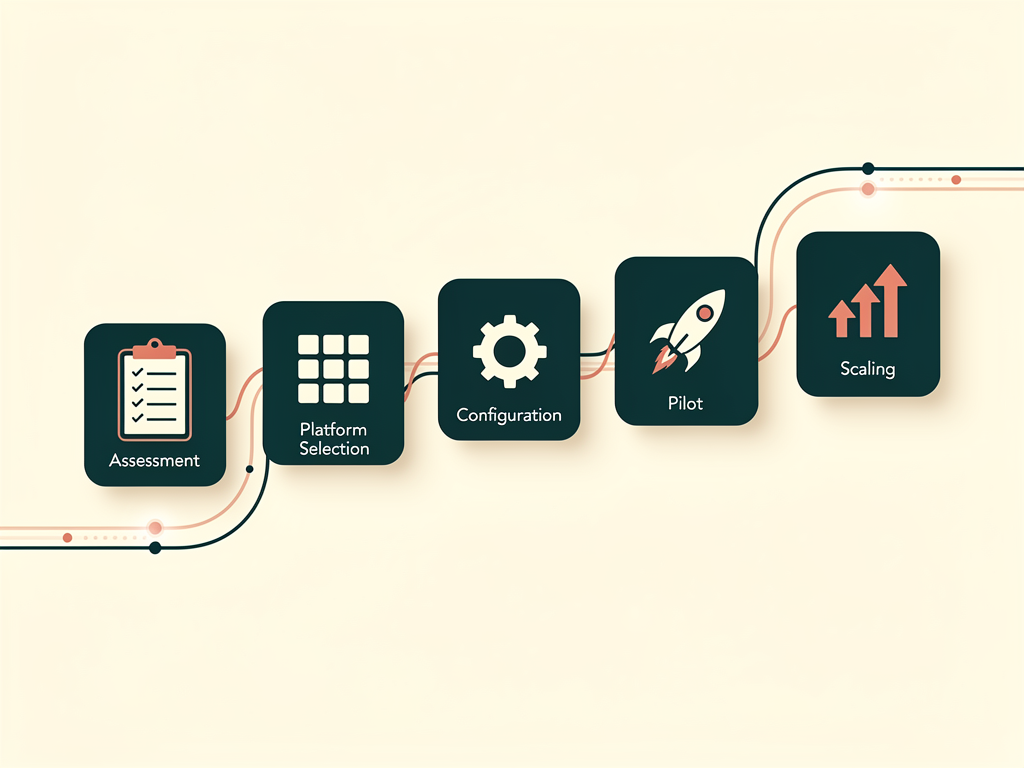
Successful AI content implementation follows a structured progression from assessment through validated scaling.
Avoiding Common Implementation Pitfalls
Experience from early AI content adopters reveals consistent patterns of implementation mistakes that organizations can avoid through awareness and proactive mitigation. Understanding these pitfalls helps businesses achieve successful outcomes while avoiding setbacks that have derailed less careful implementations.
Insufficient configuration represents the most common cause of disappointing AI content results. Organizations eager to see output often rush through setup processes, providing minimal brand information and accepting default settings. The resulting generic content fails to differentiate brands and may actually harm positioning by making businesses indistinguishable from competitors using similar tools with similar minimal configurations.
Over-reliance on automation without quality oversight leads to published content that contains errors, inconsistencies, or messaging that conflicts with brand standards. While AI systems have become remarkably capable, they remain imperfect and benefit from human review, particularly for content addressing sensitive topics, making specific claims, or targeting high-value keywords where ranking success has significant business impact.
Neglecting existing content during AI implementation wastes opportunities to leverage established assets. New AI-generated content should integrate with existing content libraries through strategic internal linking, topic coordination, and consistent messaging. Treating AI content as separate from legacy content creates fragmented user experiences and fails to maximize the authority-building potential of comprehensive content programs.
Unrealistic timeline expectations lead to frustration when SEO results do not materialize immediately. Content marketing remains a long-term strategy regardless of how content is produced, with meaningful ranking improvements typically requiring three to six months of consistent publication. Organizations expecting immediate traffic gains from AI content often abandon programs before they have opportunity to demonstrate value.
Failure to track and attribute results prevents organizations from understanding AI content ROI and making informed decisions about continued investment. Without proper analytics implementation, businesses cannot distinguish between content that drives valuable outcomes and content that consumes resources without meaningful return. This measurement gap leads to either premature program termination or continued investment in ineffective approaches.

Awareness of common implementation pitfalls enables organizations to avoid mistakes that have derailed less careful AI content programs.
Conclusion
The integration of artificial intelligence into search engine optimization and content marketing represents a fundamental transformation rather than an incremental improvement. Organizations that embrace these technologies gain access to capabilities that were previously impossible regardless of budget or team size: comprehensive keyword research completed in minutes, content production at scale without proportional cost increases, automated technical optimization, and systematic backlink acquisition through intelligent networks.
The democratization of sophisticated SEO capabilities through AI platforms has leveled competitive playing fields, enabling small businesses and solo entrepreneurs to compete effectively against larger organizations with established marketing teams. This accessibility creates both opportunities and imperatives, as businesses that fail to adopt these technologies will find themselves increasingly disadvantaged against competitors who leverage AI to produce more content, optimize more comprehensively, and build authority more rapidly.
Success with AI-driven content strategies requires more than simply adopting tools. It demands thoughtful implementation that includes comprehensive configuration, strategic integration with existing operations, appropriate quality oversight, and patient commitment to long-term authority building. Organizations that approach AI content as a strategic capability rather than a tactical shortcut position themselves for sustainable competitive advantages that compound over time.
The trajectory of these technologies points toward even more sophisticated capabilities in coming years, with agentic systems capable of autonomous optimization, predictive strategies that anticipate market changes, and personalization at scales previously impossible. Early adopters who build expertise and infrastructure now will be best positioned to leverage these advancing capabilities as they emerge, extending their advantages over competitors who delay adoption.
Frequently Asked Questions
Will Search Engines Penalize AI-Generated Content?
Search engines including Google have explicitly stated that AI-generated content is not inherently problematic and will not be penalized simply because of its generation method. The critical factor is content quality and user value rather than production method. Google's helpful content guidelines apply equally to human-written and AI-generated content, rewarding material that demonstrates expertise, provides genuine value, and satisfies user intent while penalizing thin, manipulative, or unhelpful content regardless of how it was created. Businesses using AI content platforms that prioritize quality, accuracy, and user value produce content that aligns with search engine guidelines. The key is ensuring that AI systems are properly configured with accurate knowledge bases, appropriate brand voice settings, and quality controls that prevent publication of substandard material.
How Much Does AI Content Generation Typically Cost Compared to Traditional Methods?
AI content generation typically costs 60-80% less than equivalent traditional content production methods while enabling significantly higher output volumes. Traditional agency content often costs $300-$500 per article when accounting for research, writing, editing, and optimization, while freelance writers typically charge $150-$300 for comparable quality. AI content platforms with human editing oversight generally produce equivalent quality content for $50-$100 per article, and fully automated platforms can reduce costs to $20-$50 per piece. These economics become even more favorable at scale, as AI platforms typically offer volume pricing that further reduces per-article costs for high-volume programs. The cost advantages compound when considering the time savings from automated publishing, keyword research, and optimization that would otherwise require additional staff hours or agency fees.
How Long Does It Take to See SEO Results From AI-Generated Content?
SEO results from AI-generated content follow similar timelines to traditionally produced content, typically requiring three to six months of consistent publication before meaningful ranking improvements become apparent. Search engines need time to crawl, index, and evaluate new content, and authority signals build gradually as content accumulates engagement metrics and backlinks. However, AI content programs often achieve results faster in aggregate because they enable higher publication volumes that accelerate authority building. A program publishing 30-60 articles monthly builds topical coverage and internal linking structures more rapidly than programs producing 8-12 articles monthly, potentially compressing the timeline to meaningful results. Quick wins on low-competition long-tail keywords may appear within weeks, while competitive head terms typically require sustained effort over six to twelve months.
Can AI Content Maintain Consistent Brand Voice Across Large Content Libraries?
Modern AI content platforms excel at maintaining brand voice consistency when properly configured, often achieving greater consistency than human writing teams where individual style variations are inevitable. The key lies in comprehensive brand voice configuration that specifies tone, vocabulary preferences, messaging frameworks, and examples of ideal content. Platforms that allow extensive customization through knowledge bases and style guidelines produce content that matches existing brand libraries seamlessly. This consistency actually represents an advantage over traditional content production, where different writers, editors, and agencies introduce variations that can fragment brand identity over time. Organizations should invest significant effort in initial brand voice configuration and periodically audit output to ensure continued alignment as content libraries grow.
What Types of Content Work Best With AI Generation?
AI content generation excels with informational content including how-to guides, explanatory articles, comparison pieces, and comprehensive topic overviews that benefit from thorough research and structured presentation. These content types align well with AI capabilities for synthesizing information, maintaining logical organization, and ensuring comprehensive topic coverage. Product descriptions, category page content, and FAQ sections also translate well to AI generation, particularly when systems have access to product databases and customer question histories. Content requiring original reporting, personal narratives, or highly specialized technical expertise may benefit from human creation or AI-human collaboration approaches. The most effective strategies often combine AI generation for high-volume informational content with human creation for thought leadership pieces, original research, and content requiring authentic personal perspectives.
How Do Automated Backlink Exchange Networks Differ From Traditional Link Building?
Automated backlink exchange networks streamline the traditionally labor-intensive process of link acquisition by connecting relevant websites for mutual linking arrangements without requiring manual outreach, negotiation, and relationship management. Traditional link building typically involves identifying prospects, crafting personalized outreach emails, following up multiple times, and negotiating placement terms, with success rates often below 5% of contacts. Exchange networks automate partner matching based on topical relevance and quality metrics, handle link placement verification, and monitor ongoing link health. The key distinction from manipulative link schemes lies in the quality controls these networks implement, ensuring that participating sites meet minimum standards and that links appear within genuinely valuable content contexts rather than artificial link farms. This approach delivers predictable link acquisition at costs that make comprehensive link building accessible to businesses that could never afford traditional outreach campaigns at equivalent scale.
Ready to Transform Your Content Marketing Strategy?
The future of SEO belongs to organizations that harness AI automation to produce high-quality, optimized content at scale while building sustainable competitive advantages through strategic implementation. Whether you are an agency seeking to scale client services, a content manager looking to increase output without proportional budget increases, or a business owner wanting to compete effectively in content-intensive markets, AI-powered content platforms offer the capabilities you need to succeed. Explore SeoSmart's comprehensive AI content platform to discover how automated content sprints, intelligent backlink networks, and seamless CMS integration can revolutionize your approach to search engine optimization and content marketing.
Subscribe to our newsletter
Subscribe to our newsletter and stay up-to-date with the latest news and updates.