Automated SEO Optimization: Revolutionizing Your Strategy
Discover how AI-powered platforms automate SEO tasks like keyword research, content creation, and link building, freeing marketers to focus on strategy. Learn about the evolution from manual tools to intelligent systems that enhance organic visibility in the digital landscape.

Zakariae

Search engine optimization has always demanded a relentless commitment to detail. From keyword research and content creation to technical audits and link building, the sheer volume of tasks can overwhelm even the most experienced marketing teams. For years, professionals accepted this reality, manually executing hundreds of micro-optimizations while watching competitors gain ground. Today, that paradigm is shifting dramatically. The emergence of sophisticated AI-powered platforms has made it possible to systematically automate the most time-consuming aspects of SEO, freeing strategists to focus on high-level decisions while algorithms handle the execution. This transformation represents more than convenience; it fundamentally changes how businesses can compete for organic visibility in an increasingly crowded digital landscape.
Key Takeaways
- Automated SEO optimization combines AI content generation, technical monitoring, and strategic link building into unified workflows that operate continuously without manual intervention.
- Modern autopilot systems can research keywords, generate long-form articles, add images and videos, publish directly to your CMS, and build backlinks through exchange networks.
- Small businesses and enterprise teams alike benefit from automation by redirecting hours previously spent on repetitive tasks toward strategy and relationship building.
- Effective automation requires proper setup, including knowledge base configuration, content templates, and CMS integration to ensure brand consistency.
- The best platforms support multiple languages, schema markup generation, and internal linking to maximize each piece of content's ranking potential.
- Human oversight remains essential for quality control, strategic direction, and maintaining authentic brand voice across automated content.
Understanding the Evolution of SEO Automation
The journey toward automated search optimization began with simple tools that scheduled social media posts and tracked keyword rankings. These early solutions addressed narrow pain points but required significant manual effort to connect disparate workflows. A marketer might use one tool for keyword research, another for content briefs, a third for writing assistance, and yet another for publishing. The cognitive load of managing multiple platforms, each with its own learning curve and subscription fee, often negated the efficiency gains these tools promised.
The next evolutionary phase introduced rule-based automation. Platforms could execute predefined actions when certain conditions were met, such as automatically redirecting broken links or regenerating XML sitemaps on a schedule. While valuable, these systems lacked the intelligence to adapt to changing circumstances or make nuanced decisions about content strategy. They followed instructions but could not reason about whether those instructions still made sense given current search trends or competitive dynamics.
Today's AI-powered autopilot systems represent a quantum leap forward. Rather than simply following rules, these platforms employ machine learning models that can analyze search intent, generate human-quality content, optimize for semantic relevance, and even predict which topics will resonate with target audiences. According to recent analysis from SearchAtlas, the distinction between automation and true autopilot lies in autonomous decision-making: modern systems identify issues, prioritize them by impact, generate fixes, and deploy changes without requiring developer tickets or manual approval for routine optimizations.

Core Components of an Automated SEO System
Building an effective automated SEO operation requires integrating several distinct capabilities into a cohesive workflow. Each component addresses a specific challenge in the optimization process, and the most powerful platforms combine these elements seamlessly. Understanding what each piece contributes helps marketers evaluate solutions and configure systems that match their specific needs.
Keyword research and topic discovery form the foundation of any content strategy. Automated systems can continuously monitor search trends, analyze competitor content gaps, and identify emerging opportunities before they become saturated. Rather than conducting periodic keyword research sessions, autopilot platforms maintain living databases of relevant terms and automatically suggest or generate content targeting the most promising opportunities.
Content generation engines powered by large language models can produce long-form articles, product descriptions, meta titles, and schema markup at scale. The best systems allow extensive customization through knowledge bases, brand guidelines, and content templates that ensure consistency across hundreds or thousands of pieces. These engines have matured significantly, with leading models producing content that requires minimal editing before publication.
Technical optimization modules handle the infrastructure elements that affect crawlability and indexation. Automated systems can generate and update XML sitemaps, implement canonical tags, identify and fix broken links, and monitor Core Web Vitals. When issues arise, sophisticated platforms can either fix them automatically or alert human operators with specific remediation recommendations.
Publishing and distribution workflows connect content creation to live websites. Integration with content management systems like WordPress, Webflow, Shopify, and Ghost enables one-click or fully automated publishing. Advanced platforms can schedule content releases, add internal links to existing pages, and even repurpose articles for social media distribution.
Link building automation represents perhaps the most challenging aspect of SEO to systematize. While outreach and relationship building resist full automation, platforms like SeoSmart's AI-powered content platform have developed backlink exchange networks that facilitate legitimate link acquisition without manual outreach. These networks match sites with relevant partners and coordinate reciprocal linking arrangements that benefit all participants.
Why Traditional SEO Workflows Are Becoming Unsustainable
The economics of manual SEO have shifted dramatically over the past decade. Content expectations have increased exponentially, with comprehensive articles now routinely exceeding 3,000 words to compete for competitive terms. Google's helpful content updates have raised the bar for quality, requiring genuine expertise and original insights rather than thin, keyword-stuffed pages. Meanwhile, the proliferation of AI-generated content means that simply producing more articles no longer guarantees competitive advantage.
Consider the time investment required for a single high-quality article under traditional workflows. Keyword research and topic validation might take 30 minutes to an hour. Creating a detailed content brief requires another hour. Writing 3,000 words of original content typically demands four to eight hours from a skilled writer. Editing, formatting, adding images, and optimizing metadata adds another two to three hours. Finally, publishing, internal linking, and promotion require additional effort. A single article can easily consume 10 to 15 hours of professional time.
For businesses targeting dozens or hundreds of keywords, this math becomes prohibitive. Hiring enough writers and editors to maintain consistent publishing schedules strains budgets. Quality control becomes increasingly difficult as volume increases. And the opportunity cost of having skilled strategists spend their time on execution rather than planning compounds over months and years.
The competitive landscape has also intensified. Businesses that adopted automation early have built substantial content libraries and domain authority while their competitors struggled to keep pace manually. According to insights from AIOSEO's analysis of WordPress automation, teams implementing comprehensive automation workflows save 20 or more hours per week while maintaining or improving content quality. That time advantage compounds into significant competitive differentiation over quarters and years.

Setting Up Your Automated Content Pipeline
Transitioning from manual processes to automated workflows requires thoughtful configuration to ensure the system produces content aligned with your brand and objectives. The setup phase represents an investment that pays dividends across every piece of content the system generates. Rushing this stage often leads to generic output that requires extensive revision, negating much of the efficiency benefit.
Knowledge base development provides the foundation for brand-consistent content. This involves documenting your company's unique value propositions, product details, target audience characteristics, competitive positioning, and preferred terminology. Advanced platforms allow you to upload existing content, product documentation, and style guides that the AI references when generating new material. The more comprehensive your knowledge base, the more accurately the system can represent your brand voice.
Content template configuration establishes structural patterns for different content types. You might create templates for how-to guides, product comparisons, industry news analysis, and thought leadership pieces. Each template specifies elements like required sections, approximate word counts, image placement, and call-to-action positioning. Templates ensure consistency while allowing flexibility for topic-specific variations.
CMS integration connects your content generation system to your publishing platform. Most modern autopilot solutions support direct integration with WordPress, Webflow, Shopify, Ghost, and other popular systems. Configuration typically involves installing a plugin or providing API credentials. Once connected, content can flow directly from generation to publication with appropriate formatting, categories, and metadata preserved.
Establishing quality control checkpoints ensures automated content meets your standards before publication. Some organizations prefer fully automated publishing for certain content types while requiring human review for others. Configuring approval workflows, setting up notification systems, and establishing clear criteria for what requires manual intervention helps balance efficiency with quality assurance.
Leveraging AI for Keyword Research and Topic Planning
Traditional keyword research involved hours of manual work in tools like Google Keyword Planner, analyzing search volumes, competition levels, and related terms. While these tools remain valuable, AI-powered platforms have transformed this process into a continuous, automated operation that surfaces opportunities in real-time rather than through periodic research sessions.
Modern systems analyze your existing content and automatically identify gaps in your topic coverage. By comparing your published articles against competitor content and search demand data, these platforms generate prioritized lists of topics you should address. The most sophisticated tools consider not just search volume but also your site's current authority, the competitive difficulty of ranking, and the commercial intent behind different queries.
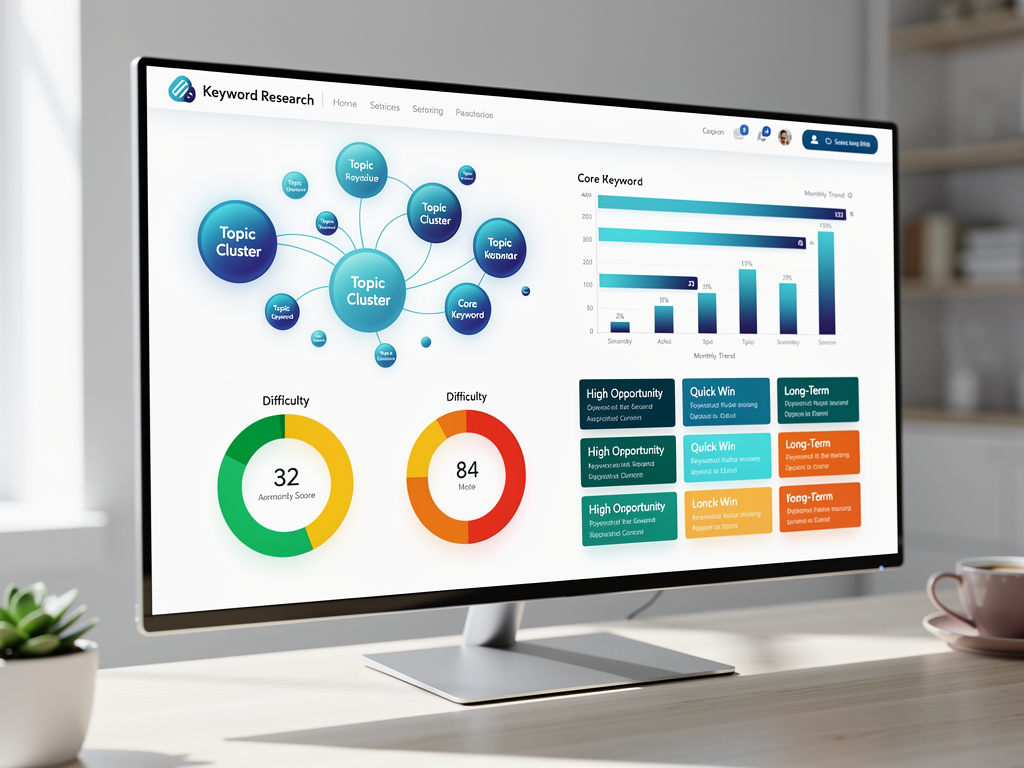
Semantic clustering represents a significant advancement in automated topic planning. Rather than targeting individual keywords in isolation, AI systems group related terms into topical clusters that support comprehensive coverage of subject areas. This approach aligns with how modern search engines understand content, rewarding sites that demonstrate thorough expertise on topics rather than superficial coverage of many disconnected keywords.
Automated systems can also monitor trending topics and emerging search patterns in your industry. By analyzing news sources, social media discussions, and search trend data, these platforms identify opportunities to create timely content before competition intensifies. This proactive approach to content planning helps establish authority on emerging topics while they remain relatively uncontested.
The AI keyword research capabilities in modern platforms extend beyond simple volume metrics. They can analyze search intent, categorizing queries as informational, navigational, commercial, or transactional. This classification helps prioritize content creation based on business objectives, ensuring you invest resources in content that drives meaningful outcomes rather than just traffic.
Automating Long-Form Content Creation
The ability to generate comprehensive, SEO-optimized articles at scale represents the most transformative capability of modern autopilot systems. What once required days of writer time can now be accomplished in minutes, with quality levels that often match or exceed manually produced content. Understanding how to configure and leverage these systems effectively maximizes their value.
Article structure optimization ensures generated content follows patterns that perform well in search results. AI systems analyze top-ranking content for target keywords and identify common structural elements, including heading hierarchies, section lengths, and content types like lists, tables, and FAQs. Generated articles incorporate these patterns while maintaining originality in the actual content.
The best content generation platforms produce articles of substantial length, often reaching 5,000 words or more for comprehensive topic coverage. This depth allows for thorough exploration of subjects, naturally incorporating related keywords and addressing the full range of user questions. Longer content also provides more opportunities for internal linking and tends to accumulate backlinks more readily than thin articles.
Image generation and integration adds visual appeal and breaks up long text passages. Modern platforms can automatically generate relevant images using AI models like FLUX.2 Pro, creating custom visuals that match article content rather than relying on generic stock photography. These images include appropriate alt text for accessibility and additional SEO value.
Video embedding enhances content engagement and time-on-page metrics. Automated systems can identify relevant YouTube videos and embed them at appropriate points within articles. This multimedia approach provides additional value to readers while signaling content quality to search engines through improved engagement signals.
Internal linking automation connects new content to your existing article library. Rather than manually identifying linking opportunities, AI systems analyze your content inventory and automatically insert relevant internal links. This practice distributes page authority throughout your site and helps search engines understand the relationships between your content pieces.
Technical SEO Automation Strategies
While content creation often receives the most attention, technical SEO elements significantly impact ranking potential. Automated systems can monitor and maintain technical health continuously, addressing issues before they affect performance. This proactive approach prevents the accumulation of technical debt that often plagues manually managed sites.
Schema markup generation helps search engines understand your content's structure and context. Automated platforms can generate appropriate schema for articles, FAQs, how-to guides, products, and other content types. This structured data enhances search result appearances through rich snippets and improves the likelihood of appearing in featured positions.
XML sitemap management ensures search engines can efficiently discover and crawl your content. Automated systems update sitemaps whenever new content is published, removing deleted pages and adjusting priority signals based on content importance. This maintenance happens invisibly, eliminating a common source of indexation problems.
Redirect management preserves link equity when URLs change or content is consolidated. Automated monitoring identifies broken links and can implement appropriate redirects without manual intervention. For sites with large content libraries, this capability prevents the gradual erosion of authority that occurs when internal and external links point to non-existent pages.
Meta title and description optimization affects click-through rates from search results. AI systems can generate compelling, keyword-optimized metadata for every page, testing different variations and updating underperforming elements. This continuous optimization improves organic traffic even without ranking changes by increasing the percentage of searchers who click through to your content.
Core Web Vitals monitoring tracks the page experience signals that Google uses as ranking factors. Automated systems can identify pages with performance issues and either implement fixes automatically or alert developers to problems requiring manual attention. Maintaining strong Core Web Vitals across large sites would be impractical without automated monitoring.

Building Backlinks Through Automated Exchange Networks
Link building has traditionally been the most labor-intensive aspect of SEO, requiring extensive outreach, relationship development, and negotiation. While these human elements remain valuable for high-authority link acquisition, automated exchange networks have emerged as a scalable complement that can build a foundation of relevant backlinks without manual effort.
Backlink exchange networks connect sites with similar audiences and complementary content. Participants agree to link to each other's relevant content, creating mutual benefit without the transactional nature of paid links. These arrangements, when properly structured around topical relevance, provide legitimate link signals that search engines value.
The key to effective automated link building lies in relevance matching. Quality platforms analyze content topics, audience demographics, and domain authority to ensure link exchanges occur between genuinely related sites. A technology blog linking to another technology resource provides more value than random cross-industry linking that search engines might view skeptically.
Automated systems can also identify link building opportunities within your own content. By analyzing your article library, these platforms find natural places to add links to partner content and suggest reciprocal opportunities. This systematic approach ensures consistent link velocity without the feast-or-famine pattern common in manual outreach campaigns.
The backlink exchange network approach works particularly well for newer sites that lack the domain authority to attract organic backlinks. By participating in legitimate exchange programs, these sites can build foundational authority while their content library grows. Over time, high-quality content begins attracting natural links, reducing dependence on exchange programs.
Monitoring and reporting on backlink acquisition helps track the effectiveness of automated link building. Quality platforms provide visibility into new links acquired, their source domains, and the anchor text distribution. This data helps ensure link profiles appear natural and diverse, avoiding patterns that might trigger algorithmic penalties.
Multi-Language Content Automation
Businesses targeting international markets face the challenge of producing optimized content in multiple languages. Manual translation and localization processes are expensive and slow, often resulting in delayed market entry or thin content in secondary languages. Automated systems have transformed this challenge into a manageable workflow.
AI-powered translation has reached quality levels that rival professional human translation for many content types. Modern language models understand context, idiom, and nuance in ways that earlier machine translation could not match. This capability allows businesses to produce native-quality content in dozens of languages from a single source article.
Beyond simple translation, effective localization requires adapting content to cultural contexts. Automated systems can adjust examples, references, and even content structure to match expectations in different markets. A comparison article might emphasize different product features for European versus Asian audiences based on regional preferences and competitive landscapes.
Supporting over 150 languages, modern platforms enable truly global content strategies. Businesses can target long-tail keywords in languages where competition remains relatively low, establishing authority before markets mature. This first-mover advantage in emerging language markets can provide lasting competitive benefits.
Hreflang implementation ensures search engines serve the correct language version to users in different regions. Automated systems can generate and maintain hreflang tags across multilingual content, preventing duplicate content issues and ensuring users find content in their preferred language. Manual hreflang management becomes impractical at scale, making automation essential for international SEO.

Integrating Automation with Your Existing Tech Stack
Most businesses have established tools and workflows that cannot be abandoned when adopting automation. Effective autopilot platforms integrate with existing systems rather than requiring wholesale replacement. Understanding integration capabilities helps ensure smooth adoption and maximum value extraction.
CMS integration represents the most critical connection point. Whether you use WordPress, Webflow, Shopify, Ghost, or custom solutions, automated content needs a path to publication. The best platforms offer native integrations that preserve formatting, handle media uploads, and respect your existing content workflows. For systems without native support, webhook and API options provide flexibility.
Analytics integration enables automated systems to learn from performance data. By connecting to Google Search Console and analytics platforms, autopilot systems can identify which content performs well and adjust future generation accordingly. This feedback loop continuously improves content quality and relevance based on actual user behavior.
Project management tool integration keeps teams informed about automated activities. Notifications can flow to Slack, email, or project management platforms when content is generated, published, or requires review. This visibility ensures human operators maintain awareness without needing to constantly check automation dashboards.
CRM integration enables content personalization based on audience segments. Automated systems can generate variations of content targeting different buyer personas or funnel stages, with distribution controlled by CRM data. This sophisticated approach maximizes content relevance while maintaining automation efficiency.
| Integration Type | Primary Benefit | Common Platforms |
|---|---|---|
| CMS | Direct publishing without manual upload | WordPress, Webflow, Shopify, Ghost |
| Analytics | Performance-based content optimization | Google Search Console, Google Analytics |
| Communication | Team notifications and approvals | Slack, Email, Microsoft Teams |
| Project Management | Workflow visibility and task tracking | Asana, Monday, Trello |
| CRM | Audience segmentation and personalization | HubSpot, Salesforce, Pipedrive |
Measuring ROI from Automated SEO Operations
Justifying investment in automation requires clear metrics that demonstrate value. While time savings provide the most immediate benefit, comprehensive ROI analysis considers multiple factors including content output, ranking improvements, traffic growth, and ultimately revenue impact. Establishing measurement frameworks before implementation enables accurate before-and-after comparisons.
Content production metrics quantify the volume increase automation enables. Track articles published per month, average word count, and time from topic identification to publication. Most organizations see three to ten times increases in content output after implementing comprehensive automation, with corresponding reductions in cost per article.
Ranking improvements demonstrate SEO effectiveness. Monitor keyword positions for target terms, tracking how many keywords rank in top 10, top 20, and top 50 positions. Automated content strategies typically show steady ranking improvements over three to six months as content libraries grow and internal linking strengthens site architecture.
Traffic growth translates rankings into actual visitors. Organic traffic increases provide the clearest indication that automated content resonates with search engines and users. Segment traffic by content type and publication date to understand which automated content performs best and refine templates accordingly.
Conversion and revenue metrics connect SEO performance to business outcomes. Track how automated content contributes to lead generation, email signups, product purchases, or other conversion goals. Attribution modeling helps understand the role of automated content in customer journeys, even when conversions occur through other channels.
Time savings calculations quantify the efficiency benefit. Compare hours previously spent on content creation, technical maintenance, and link building against current time investment. Many teams redirect saved hours toward strategy, relationship building, and high-value activities that automation cannot replace.

Common Pitfalls and How to Avoid Them
While automation offers tremendous benefits, implementation mistakes can undermine results or even damage search performance. Understanding common pitfalls helps organizations avoid costly errors and maximize their automation investment. Most problems stem from either over-reliance on automation or insufficient configuration.
Generic content syndrome occurs when automated systems lack sufficient brand context. Without detailed knowledge bases and templates, AI generates technically correct but undifferentiated content that fails to establish thought leadership or brand identity. The solution involves investing adequate time in setup, providing extensive examples of preferred content, and continuously refining templates based on output quality.
Ignoring quality control creates risks of publishing substandard or inaccurate content. While modern AI produces impressive output, errors still occur. Establishing review processes, even lightweight ones, catches problems before publication. Consider tiered approaches where certain content types receive full review while others undergo spot-checking.
Over-optimization penalties can result from automated systems that prioritize keyword density over natural readability. Quality platforms balance optimization with user experience, but configuration settings sometimes need adjustment. Monitor content for awkward phrasing or excessive keyword repetition and adjust generation parameters accordingly.
Neglecting human elements weakens overall SEO performance. Automation excels at execution but cannot replace strategic thinking, relationship building, or genuine expertise. Organizations that view automation as a complete replacement for human involvement rather than an amplifier of human capability often see diminishing returns over time.
Failing to monitor and iterate prevents continuous improvement. Automated systems require ongoing attention to configuration, performance analysis, and refinement. Treating automation as "set and forget" misses opportunities to improve output quality and adapt to changing search algorithms or competitive dynamics.
Pro Tip: Schedule monthly automation audits to review content quality, check for technical issues, and refine templates based on performance data. This small time investment prevents the accumulation of problems that can undermine long-term results.
The Role of Human Oversight in Automated Systems
Despite impressive AI capabilities, human involvement remains essential for optimal results. Understanding where human judgment adds the most value helps organizations allocate attention effectively, focusing expertise on high-impact decisions while allowing automation to handle routine execution.
Strategic direction requires human insight into business objectives, competitive positioning, and market dynamics. Automated systems optimize toward defined goals but cannot determine what those goals should be. Humans must decide which markets to target, what brand voice to maintain, and how SEO fits within broader marketing strategies.
Quality assurance ensures automated output meets standards before reaching audiences. While review requirements vary by content type and risk level, some human oversight prevents embarrassing errors or off-brand messaging. Establishing clear criteria for what requires review versus what can publish automatically balances efficiency with quality control.
Relationship building in link acquisition and industry networking resists automation. While exchange networks provide baseline link building, the highest-authority backlinks come from genuine relationships with industry peers, journalists, and influencers. Human effort in building these relationships complements automated link building for comprehensive authority development.
Algorithm adaptation requires human interpretation of search engine changes. When Google releases updates, automated systems may need configuration adjustments to maintain effectiveness. Humans must monitor industry news, interpret ranking fluctuations, and update automation parameters to align with evolving best practices.
Creative differentiation separates exceptional content from competent content. While AI generates solid articles, breakthrough content that earns viral sharing and premium backlinks often requires human creativity. Reserving some content production for human-led efforts ensures your content library includes standout pieces alongside automated volume.

Future Trends in SEO Automation
The automation landscape continues evolving rapidly, with new capabilities emerging that will further transform SEO workflows. Understanding these trends helps organizations prepare for changes and evaluate platforms based on their innovation trajectories rather than just current features.
Autonomous SEO agents represent the next frontier in automation sophistication. Rather than executing predefined workflows, these systems make independent decisions about what to optimize, when to act, and how to prioritize competing opportunities. Early implementations already demonstrate the potential for truly hands-off SEO management where human involvement focuses purely on strategic oversight.
AI visibility optimization addresses the growing importance of appearing in AI-generated search results. As users increasingly interact with ChatGPT, Perplexity, and similar tools, optimizing for AI citation becomes as important as traditional ranking. Forward-looking platforms are developing capabilities to monitor and improve visibility in these emerging channels.
Predictive content planning uses machine learning to forecast which topics will gain search interest before trends emerge. By analyzing patterns across news, social media, and search data, these systems identify content opportunities with lead time that enables first-mover advantage. This proactive approach contrasts with reactive strategies that respond to established demand.
Personalization at scale will enable automated systems to generate content variations targeting specific audience segments, geographic regions, or funnel stages. Rather than one-size-fits-all content, future platforms will produce tailored versions that maximize relevance for different user groups while maintaining production efficiency.
Integration depth will increase as platforms develop more sophisticated connections with business systems. Automated content that incorporates real-time inventory data, customer testimonials, or competitive pricing creates more valuable, differentiated content than generic articles. These integrations require technical complexity but deliver significant competitive advantage.
Getting Started with Your Automation Journey
Transitioning to automated SEO operations requires a structured approach that builds capability progressively while managing risk. Organizations that attempt to automate everything simultaneously often struggle with quality control and configuration complexity. A phased approach enables learning and refinement at each stage.
Phase one focuses on content generation as the highest-impact starting point. Select a platform that aligns with your CMS and content requirements, configure knowledge bases and templates thoroughly, and begin with lower-stakes content types. Monitor output quality closely and refine configuration based on results before expanding scope.
Phase two adds technical SEO automation once content workflows stabilize. Implement automated schema markup, sitemap management, and broken link monitoring. These capabilities require less ongoing attention than content generation but provide consistent value in maintaining site health.
Phase three incorporates link building automation through exchange networks or outreach tools. This phase typically requires the most careful monitoring to ensure link quality and relevance meet standards. Start with conservative participation levels and increase as you develop confidence in partner quality.
Phase four optimizes and scales successful workflows. Analyze performance data to identify what works best, refine templates and configurations accordingly, and expand automation to additional content types or markets. This continuous improvement phase never truly ends as platforms evolve and opportunities emerge.
Throughout all phases, maintain documentation of configurations, workflows, and lessons learned. This institutional knowledge proves invaluable when onboarding team members, troubleshooting issues, or evaluating alternative platforms. Treat automation setup as an ongoing investment rather than a one-time project.

Comparing Automation Approaches for Different Business Types
Different organizations have varying needs, resources, and risk tolerances that affect optimal automation strategies. Understanding how business context influences automation decisions helps organizations select appropriate tools and configure them effectively for their specific situations.
SEO agencies and consultants benefit from automation that scales across multiple client accounts. Look for platforms offering white-label capabilities, client-specific configurations, and consolidated reporting. The ability to demonstrate automation-driven results helps agencies justify premium pricing while maintaining healthy margins.
B2B content marketing teams typically need automation that produces thought leadership content demonstrating expertise. Configuration emphasis should focus on knowledge bases that capture company methodology, case study details, and industry insights. Integration with marketing automation platforms enables content personalization based on lead scoring and segmentation.
Small business owners managing their own SEO need automation that minimizes complexity while delivering results. Platforms offering guided setup, template libraries, and hands-off operation suit this audience best. The ability to produce professional-quality content without marketing expertise democratizes SEO for resource-constrained businesses.
Affiliate marketers and niche site builders prioritize volume and keyword coverage. Automation that rapidly produces content across many topics while maintaining quality enables the scale these business models require. Integration with affiliate link management and performance tracking adds particular value for this use case.
E-commerce store owners need automation that supports product-focused content including buying guides, comparisons, and category pages. Schema markup for products and reviews, integration with inventory systems, and support for large-scale content operations address e-commerce-specific requirements.
SaaS companies requiring regular content production benefit from automation that maintains consistent publishing schedules while allowing for product update integration. The ability to automatically incorporate feature announcements, use cases, and customer success stories into content workflows supports product marketing objectives alongside SEO goals.
| Business Type | Primary Automation Priority | Key Configuration Focus |
|---|---|---|
| SEO Agencies | Multi-client scalability | White-label, client separation |
| B2B Marketing | Thought leadership quality | Deep knowledge bases, expertise demonstration |
| Small Business | Simplicity and hands-off operation | Templates, guided setup |
| Affiliate Marketing | Volume and keyword coverage | Rapid production, link management |
| E-commerce | Product content at scale | Product schema, inventory integration |
| SaaS | Consistent publishing cadence | Product update integration, feature content |

Conclusion
The transformation of SEO from a labor-intensive discipline to an automatable operation represents one of the most significant shifts in digital marketing history. Organizations that embrace this change gain substantial competitive advantages through increased content velocity, consistent technical optimization, and systematic link building. Those that cling to purely manual approaches increasingly find themselves unable to compete with the output volume and consistency that automation enables.
Success with SEO automation requires thoughtful implementation rather than blind adoption. Investing in proper configuration, maintaining appropriate human oversight, and continuously refining workflows based on performance data separates organizations that thrive from those that struggle. The technology provides tremendous capability, but extracting maximum value demands strategic application.
The platforms available today offer capabilities that would have seemed impossible just a few years ago. AI-powered content generation produces articles indistinguishable from human writing. Technical monitoring maintains site health without manual audits. Backlink exchange networks build authority without cold outreach. These capabilities, properly integrated, create SEO operations that scale efficiently while maintaining quality.
As AI technology continues advancing, automation capabilities will only expand. Organizations that develop automation competency now position themselves to adopt future innovations more readily. The learning curve for effective automation use, while manageable, requires time to climb. Starting that journey today provides advantages that compound over months and years of improved SEO performance.

Frequently Asked Questions
How long does it take to see results from automated SEO?
Most organizations begin seeing measurable improvements within three to six months of implementing comprehensive SEO automation. The timeline depends on several factors including your site's existing authority, the competitiveness of target keywords, and the volume of content produced. Initial gains often appear in long-tail keywords with lower competition, while more competitive terms require longer timeframes and greater content depth. Consistency matters more than speed; automated systems that maintain steady publishing schedules typically outperform sporadic manual efforts even when total content volume is similar. Track progress through keyword ranking improvements, organic traffic growth, and indexed page counts to understand how your specific implementation performs.
Can automated content rank as well as human-written content?
Modern AI-generated content regularly achieves top rankings for competitive keywords when properly configured. The key factors determining ranking success include the quality of knowledge base information provided to the system, appropriate template configuration, and sufficient content depth. Google's algorithms evaluate content based on helpfulness, accuracy, and user satisfaction rather than whether humans or AI produced it. Studies comparing automated and manual content performance show minimal differences when automation systems have access to comprehensive brand and topic information. The most successful approaches combine AI efficiency with human oversight for quality assurance, capturing the benefits of both approaches while mitigating their respective weaknesses.
What is the cost difference between manual and automated SEO?
Automated SEO typically reduces content production costs by 60 to 80 percent compared to fully manual approaches. A comprehensive article that might cost $300 to $500 when produced by professional writers can be generated for $10 to $50 through automation platforms, depending on the specific tool and configuration. Beyond direct production costs, automation eliminates significant time investments in coordination, editing, and publishing workflows. Most platforms operate on subscription models ranging from $50 to $500 monthly depending on features and volume. Organizations producing more than five to ten articles monthly typically achieve positive ROI within the first month of automation adoption, with savings compounding as volume increases.
How do I maintain brand voice with automated content?
Maintaining consistent brand voice requires thorough knowledge base configuration and ongoing refinement. Start by documenting your brand's communication style, preferred terminology, tone characteristics, and examples of ideal content. Upload existing high-performing content as reference material for the AI system. Create detailed templates that specify structural elements, required sections, and stylistic guidelines. Review initial automated output carefully and provide feedback through configuration adjustments. Most organizations find that brand voice consistency improves significantly over the first few weeks as they refine their setup. Consider maintaining a style guide document that evolves based on what works and sharing it with the automation platform through knowledge base updates.
Is automated link building safe for SEO?
Legitimate automated link building through exchange networks and content-based acquisition is safe when implemented properly. The key distinction lies between manipulative link schemes and genuine value exchange. Quality automation platforms facilitate connections between topically relevant sites where linking provides mutual benefit to audiences. These arrangements mirror natural linking patterns that occur organically between related content. Avoid platforms that promise unrealistic link volumes, use private blog networks, or ignore topical relevance. Monitor your backlink profile regularly for quality and diversity, ensuring anchor text distribution appears natural. When done correctly, automated link building accelerates authority development while maintaining compliance with search engine guidelines.
What technical requirements do I need for SEO automation?
Most SEO automation platforms require minimal technical infrastructure beyond a functioning website and CMS access. WordPress sites need plugin installation capabilities, while other platforms typically require API credentials or webhook configuration. Ensure your hosting can handle increased publishing volume without performance degradation. Google Search Console verification enables performance tracking and optimization feedback loops. For advanced implementations, consider dedicated staging environments for testing automation configurations before production deployment. Most platforms provide detailed setup documentation and support resources. Organizations without technical staff can typically complete setup independently, though complex integrations may benefit from developer assistance during initial configuration.
Ready to Transform Your SEO Operations?
Stop spending countless hours on manual content creation, technical optimization, and link building. SeoSmart provides everything you need to put your rankings on autopilot. With AI-powered content generation producing brand-tailored 5,000-word articles complete with images, internal links, and YouTube videos, plus automatic publishing and backlink building through our exchange network, you can finally focus on strategy while the platform handles execution. Start with 500 free credits and discover how automated SEO can transform your organic growth. Visit SeoSmart.app today to begin your automation journey.
Subscribe to our newsletter
Subscribe to our newsletter and stay up-to-date with the latest news and updates.