AI-Powered SEO Competitive Analysis: Uncover Content Gaps
Discover how AI transforms competitive analysis in SEO, revealing content gaps your rivals overlook. Learn to leverage AI for proactive strategies and market leadership.

Zakariae

Every search result you do not rank for represents revenue flowing directly into a competitor's pocket. While most marketers understand this reality, few possess the strategic framework to systematically identify and exploit the content gaps their rivals have overlooked. The difference between websites that dominate search results and those that languish on page two often comes down to one critical discipline: the ability to conduct thorough competitive analysis SEO and transform those insights into actionable content strategies.
Traditional approaches to competitor research involved hours of manual spreadsheet work, toggling between multiple tools, and making educated guesses about which opportunities deserved attention. Today, artificial intelligence has fundamentally transformed this landscape, enabling marketers to process vast amounts of competitor data, identify patterns invisible to human analysis, and uncover content opportunities that would otherwise remain hidden. This shift represents more than incremental improvement; it constitutes a complete reimagining of how businesses can outmaneuver their competition in organic search.
Key Takeaways
- AI-powered competitor analysis processes thousands of data points simultaneously, revealing content gaps that manual research consistently misses.
- Content gap identification goes beyond keyword matching to include semantic relationships, user intent patterns, and topical authority opportunities.
- Strategic prioritization frameworks help you focus resources on high-impact opportunities rather than chasing every possible keyword.
- Automated monitoring systems track competitor movements in real-time, enabling proactive rather than reactive content strategies.
- Integration with content production workflows transforms competitive insights into published articles that capture market share.
- Backlink gap analysis reveals link building opportunities where competitors have established authority you can replicate or exceed.

Understanding the Modern Competitive Landscape in Search
The search ecosystem has evolved dramatically over the past several years, creating both challenges and opportunities for businesses seeking organic visibility. Search engines now evaluate content through increasingly sophisticated lenses, considering factors like topical authority, user engagement signals, and semantic relevance alongside traditional ranking factors. This complexity means that simply identifying keywords your competitors rank for no longer provides sufficient strategic direction.
Modern competitive analysis requires understanding the full context of your market's search landscape. This includes recognizing which competitors dominate specific topic clusters, understanding the content formats that perform best in your niche, and identifying the gaps where user demand exists but quality content does not. AI systems excel at processing this multidimensional data, connecting dots that would take human analysts weeks to identify manually.
Consider the typical B2B software company competing for visibility in a crowded market. Their competitors might include direct product alternatives, industry publications, review sites, and educational resources. Each of these competitor types requires different analytical approaches and presents unique opportunities for content differentiation. AI-powered analysis can simultaneously evaluate all these competitor categories, identifying where each succeeds and fails in meeting user needs.
The shift toward AI-generated search results, including featured snippets, AI overviews, and conversational search responses, adds another layer of complexity. Competitors who understand how to optimize for these emerging formats gain significant advantages, while those who ignore these changes find their visibility eroding despite maintaining traditional rankings. Comprehensive competitive analysis must now account for these new visibility opportunities and the strategies competitors employ to capture them.
Why Traditional Competitor Research Falls Short
Manual competitor analysis, while valuable, suffers from inherent limitations that AI-powered approaches overcome. Human analysts can only process a finite amount of data, leading to sampling biases and missed opportunities. When examining competitor content, manual reviewers typically focus on obvious metrics like word count and keyword density while overlooking subtle patterns in content structure, internal linking strategies, and semantic coverage that significantly impact rankings.
Time constraints compound these limitations. A thorough manual analysis of even five competitors might require several days of dedicated work, during which the competitive landscape continues evolving. By the time recommendations reach implementation, new competitor content may have already shifted the dynamics. This lag between analysis and action creates a perpetual catch-up cycle that prevents businesses from establishing market leadership.
Traditional approaches also struggle with scale. Small businesses might compete against dozens of websites for any given keyword cluster, while enterprise organizations face hundreds or thousands of competitors across their content portfolio. Manual analysis simply cannot maintain comprehensive coverage at these scales, forcing teams to make strategic decisions based on incomplete information.
The most dangerous competitor is not the one you are watching closely, but the one whose content strategy you have not yet discovered. AI-powered analysis eliminates blind spots by continuously scanning the entire competitive landscape.
Perhaps most critically, manual analysis tends to focus on what competitors are doing rather than what they are failing to do. Identifying content gaps requires understanding not just competitor coverage but also user demand, search intent variations, and topical relationships. This negative space analysis, finding opportunities in what does not exist, represents AI's most significant advantage over traditional research methods.
The AI Advantage in Content Gap Identification
Artificial intelligence transforms content gap analysis from a periodic project into a continuous strategic capability. Machine learning algorithms can simultaneously analyze thousands of competitor pages, extracting patterns in content structure, topic coverage, and semantic relationships that inform content strategy. These systems identify not just keyword gaps but conceptual gaps where competitors have failed to address specific user needs or questions.
Natural language processing enables AI systems to understand content at a semantic level, recognizing when competitors have covered a topic superficially versus comprehensively. This distinction matters enormously for content strategy, as opportunities often exist not in completely uncovered topics but in topics where existing content fails to satisfy user intent. AI can identify these quality gaps by analyzing factors like content depth, comprehensiveness, and alignment with search intent signals.

Predictive analytics add another dimension to AI-powered gap analysis. By analyzing historical patterns in competitor content publication and ranking changes, AI systems can forecast emerging opportunities before they become obvious to manual researchers. This predictive capability enables proactive content strategies that capture market share as demand develops rather than after competitors have already established dominance.
The integration of multiple data sources amplifies AI's analytical power. By combining search data, social signals, industry trends, and competitor activity patterns, AI systems develop holistic views of market opportunities. This multi-source analysis reveals connections invisible to single-channel research, such as identifying topics gaining traction on social media that competitors have not yet addressed through search-optimized content.
Building Your Competitor Identification Framework
Effective competitive analysis begins with accurate competitor identification, a task more nuanced than it initially appears. Your true SEO competitors may differ significantly from your business competitors. A local accounting firm might compete for clients against other local accountants but compete for search visibility against national publications, software companies, and educational institutions. AI-powered tools excel at identifying these search competitors by analyzing who actually ranks for your target keywords rather than who you perceive as competition.
The competitor identification process should segment competitors into meaningful categories. Direct competitors offer similar products or services to similar audiences. Indirect competitors solve the same problems through different approaches. Content competitors may not compete commercially but dominate search results for relevant queries. Each category requires different analytical approaches and presents distinct opportunities for differentiation.
| Competitor Type | Analysis Focus | Opportunity Type | Priority Level |
|---|---|---|---|
| Direct Competitors | Product comparisons, feature coverage, pricing content | Differentiation and positioning | High |
| Indirect Competitors | Alternative solutions, use case coverage | Market education and awareness | Medium |
| Content Competitors | Informational content, educational resources | Topical authority building | High |
| SERP Features | Featured snippets, knowledge panels | Visibility optimization | Medium |
Tracking the right number of competitors balances comprehensiveness with actionability. For most businesses, monitoring five to ten primary competitors provides sufficient strategic insight without overwhelming analysis capacity. However, AI systems can track significantly larger competitor sets, enabling broader market surveillance while focusing detailed analysis on priority competitors. This tiered approach ensures comprehensive coverage without sacrificing analytical depth.
Regular competitor set reviews ensure your analysis remains relevant as markets evolve. New entrants may emerge as significant competitors, while previously dominant players may decline in relevance. AI systems can automate this monitoring, flagging when new competitors begin ranking for your target keywords or when existing competitors significantly change their content strategies.
Conducting Comprehensive Keyword Gap Analysis
Keyword gap analysis forms the foundation of competitive content strategy, revealing specific terms and phrases where competitors capture traffic you could potentially earn. Modern AI-powered approaches extend beyond simple keyword matching to include semantic variations, question-based queries, and long-tail opportunities that traditional tools often miss. This comprehensive approach ensures no valuable traffic opportunity escapes notice.
The analysis process begins by aggregating the complete keyword portfolios of your identified competitors. AI systems can process thousands of keywords simultaneously, categorizing them by topic, intent, difficulty, and business value. This categorization enables strategic prioritization, focusing resources on opportunities that align with business objectives rather than chasing every possible keyword.
Intent classification represents a critical component of modern keyword gap analysis. Keywords with identical search volumes may have vastly different values depending on the intent they represent. AI systems can classify keywords into informational, navigational, commercial, and transactional intent categories, enabling strategies that target the most valuable opportunities for your specific business model.
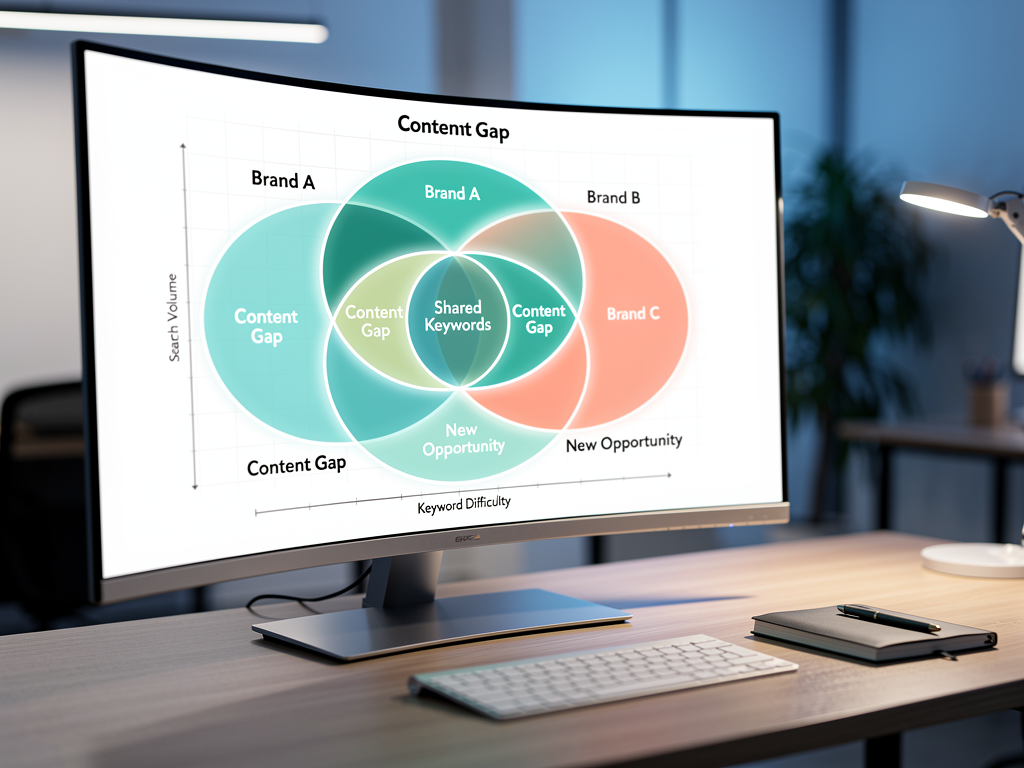
Long-tail keyword opportunities often represent the most accessible wins in competitive markets. While head terms may require significant authority to rank, long-tail variations frequently present lower competition and higher conversion intent. AI systems excel at identifying these long-tail opportunities by analyzing search patterns, question variations, and semantic relationships that expand beyond obvious keyword targets.
The output of keyword gap analysis should include not just keyword lists but strategic recommendations for content creation. Grouping related keywords into topic clusters enables efficient content production that targets multiple keywords through comprehensive coverage rather than creating separate pages for each variation. This cluster-based approach aligns with how search engines evaluate topical authority and maximizes the impact of content investments.
Analyzing Competitor Content Quality and Structure
Beyond keyword coverage, understanding how competitors structure and present their content reveals opportunities for differentiation and improvement. AI-powered content analysis evaluates factors like heading structures, content depth, multimedia usage, and internal linking patterns that contribute to ranking success. These structural insights inform content briefs that position new content for competitive advantage.
Content depth analysis examines how thoroughly competitors cover their target topics. AI systems can identify when competitor content provides surface-level coverage versus comprehensive treatment, revealing opportunities to create more valuable resources that better serve user needs. This depth advantage often proves decisive in competitive rankings, as search engines increasingly favor content that thoroughly addresses user queries.
Structural patterns across top-ranking content reveal what search engines and users expect from content on specific topics. If all top-ranking pages for a query include comparison tables, step-by-step instructions, or video content, these elements likely contribute to ranking success. AI analysis can identify these patterns across large content sets, informing content templates that incorporate proven structural elements.
Readability and engagement factors also merit analysis. AI systems can evaluate competitor content for reading level, sentence structure, and engagement patterns that correlate with user satisfaction. Content that matches user expectations for accessibility and engagement performs better in both rankings and conversions, making these factors important competitive considerations.
Internal linking strategies often differentiate successful content from underperforming pages. Analyzing how competitors connect related content reveals topical relationships and authority-building patterns worth emulating or improving upon. AI systems can map these linking structures across entire competitor sites, identifying strategic approaches to internal linking that support ranking objectives.
Leveraging Backlink Gap Analysis for Authority Building
Backlink profiles significantly influence ranking potential, making competitor backlink analysis essential for comprehensive competitive strategy. AI-powered backlink analysis goes beyond counting links to evaluate link quality, relevance, and acquisition patterns that inform realistic link building strategies. Understanding where competitors earn links reveals opportunities to pursue similar or superior link sources.
The backlink gap analysis process identifies domains linking to competitors but not to your site. These domains represent proven link opportunities, as they have already demonstrated willingness to link to content in your niche. AI systems can prioritize these opportunities based on domain authority, relevance, and likelihood of link acquisition, focusing outreach efforts on the most promising targets.

Content-based link acquisition opportunities emerge from analyzing what competitor content earns the most links. If competitor research studies, tools, or comprehensive guides attract significant links, similar content types may perform well for your site. AI analysis can identify these link-magnet content patterns, informing content strategies designed to earn authoritative links organically.
Link velocity analysis reveals how quickly competitors build links and whether their growth patterns suggest natural acquisition or artificial manipulation. Understanding these patterns helps set realistic expectations for your own link building efforts and identifies competitors whose rankings may be vulnerable to algorithm updates targeting unnatural link profiles.
The integration of backlink analysis with content gap analysis creates powerful strategic synergies. Identifying topics where competitors have both content gaps and weak backlink profiles reveals opportunities where comprehensive, well-promoted content can quickly establish dominance. These combined weaknesses represent the most accessible competitive opportunities in most markets.
Implementing Automated Competitor Monitoring Systems
Static competitive analysis quickly becomes outdated in dynamic search environments. Automated monitoring systems track competitor activities continuously, alerting you to new content, ranking changes, and strategic shifts that require response. AI-powered monitoring transforms competitive intelligence from periodic projects into ongoing strategic capabilities that inform real-time decision making.
Content monitoring tracks when competitors publish new pages, update existing content, or remove underperforming pages. These activities often signal strategic priorities and market opportunities worth investigating. AI systems can categorize competitor content changes by topic, format, and apparent intent, providing actionable intelligence rather than overwhelming notification streams.
Ranking monitoring reveals competitive dynamics as they unfold. When competitors gain or lose rankings for important keywords, understanding the causes informs your own strategy. AI analysis can correlate ranking changes with content updates, link acquisition, or algorithm updates, providing insights into what drives success in your specific market.
Social and industry monitoring extends competitive intelligence beyond search results. Tracking competitor mentions, social engagement, and industry coverage reveals brand positioning strategies and content promotion approaches worth understanding. AI systems can aggregate these signals into comprehensive competitor profiles that inform both content and broader marketing strategies.
The businesses that win in search are not those with the most resources but those with the best intelligence. Automated monitoring ensures you never miss a competitive development that could impact your strategy.
Alert configuration determines monitoring system effectiveness. Too many alerts create noise that obscures important signals, while too few may miss critical developments. AI-powered systems can learn your priorities over time, adjusting alert thresholds to surface the most strategically relevant competitor activities while filtering routine changes.
Transforming Competitive Insights into Content Strategy
Competitive analysis generates value only when insights translate into action. The bridge between analysis and execution requires systematic processes for prioritizing opportunities, creating content briefs, and managing production workflows. AI-powered platforms can automate much of this translation, accelerating the path from insight to published content.
Opportunity scoring frameworks help prioritize which gaps to address first. Factors like search volume, keyword difficulty, business relevance, and competitive vulnerability combine into composite scores that guide resource allocation. AI systems can calculate these scores automatically, maintaining updated priority lists as market conditions evolve.

Content brief generation represents a critical workflow step where competitive insights inform content creation. AI systems can automatically generate briefs that incorporate target keywords, recommended structures, competitive positioning angles, and optimization requirements. These comprehensive briefs ensure writers produce content designed to outperform competitors rather than simply matching their approaches.
Production capacity planning ensures competitive opportunities receive appropriate resources. Understanding the volume of content required to address identified gaps enables realistic planning and resource allocation. AI systems can estimate production requirements based on gap analysis results, helping teams balance ambition with execution capability.
The feedback loop between published content performance and competitive analysis refines strategy over time. Tracking how new content performs against competitive benchmarks reveals which strategic approaches succeed and which require adjustment. AI systems can automate this performance tracking, continuously improving the accuracy of opportunity assessments and content recommendations.
Optimizing Content for Competitive Advantage
Creating content that outperforms competitors requires optimization strategies informed by competitive analysis. Understanding what makes competitor content successful, and where it falls short, enables targeted improvements that capture ranking positions. AI-powered optimization tools can analyze competitor content in real-time, providing specific recommendations for achieving competitive advantage.
Semantic optimization ensures content covers topics comprehensively enough to satisfy search engine expectations. AI analysis of top-ranking competitor content reveals the semantic concepts and related topics that search engines associate with target keywords. Incorporating these elements into your content signals topical authority and relevance that supports ranking improvements.
User intent alignment represents perhaps the most critical optimization factor. Content that precisely matches what users seek when entering specific queries outperforms content optimized purely for keywords. AI systems can analyze search results and user behavior patterns to identify intent signals, informing content approaches that prioritize user satisfaction over keyword density.
Technical optimization factors like page speed, mobile responsiveness, and schema markup contribute to competitive positioning. Analyzing competitor technical implementations reveals baseline requirements and opportunities for differentiation. AI tools can audit both your content and competitor content for technical factors, identifying improvements that support ranking objectives.
Freshness and update strategies maintain competitive positions over time. Analyzing how frequently competitors update their content and how those updates correlate with ranking changes informs content maintenance schedules. AI systems can monitor content age and performance, recommending updates when competitive dynamics or content staleness threaten rankings.
Measuring Competitive Analysis ROI and Impact
Demonstrating the value of competitive analysis investments requires systematic measurement of outcomes against objectives. Tracking the right metrics ensures analysis efforts generate measurable business impact rather than producing interesting but ultimately unused insights. AI-powered analytics can automate much of this measurement, providing clear visibility into competitive analysis ROI.
Ranking improvements for targeted keywords represent the most direct measure of competitive analysis success. Tracking position changes for keywords identified through gap analysis reveals whether content strategies effectively capture identified opportunities. AI systems can attribute ranking changes to specific content initiatives, clarifying which strategies deliver results.
| Metric Category | Specific Metrics | Measurement Frequency | Target Benchmarks |
|---|---|---|---|
| Visibility | Keyword rankings, SERP features, share of voice | Weekly | Improvement vs. competitors |
| Traffic | Organic sessions, new vs. returning, engagement | Monthly | Growth rate exceeding market |
| Conversions | Leads, sales, goal completions from organic | Monthly | Positive ROI on content investment |
| Authority | Domain rating, backlink growth, brand mentions | Quarterly | Closing gap with competitors |
Traffic growth from competitive content initiatives indicates whether ranking improvements translate into meaningful visibility gains. Analyzing traffic patterns for pages created to address competitive gaps reveals the business value of those opportunities. AI systems can segment traffic by content initiative, providing clear attribution for competitive analysis investments.
Conversion metrics ultimately determine competitive analysis value. Traffic that does not convert provides limited business benefit regardless of volume. Tracking conversion rates and revenue from competitive content initiatives ensures strategies focus on opportunities that drive business outcomes rather than vanity metrics.
Competitive position tracking measures progress against specific competitors over time. Share of voice metrics, ranking distributions, and head-to-head comparisons reveal whether strategies successfully shift competitive dynamics. AI systems can automate these comparisons, providing regular competitive position reports that inform ongoing strategy refinement.
Avoiding Common Competitive Analysis Pitfalls
Even sophisticated competitive analysis can lead strategies astray when common pitfalls go unrecognized. Understanding these potential mistakes enables more effective analysis that generates actionable, accurate insights. AI systems can help identify some of these pitfalls automatically, but human judgment remains essential for avoiding strategic errors.

Competitor fixation represents a significant risk where businesses become so focused on matching competitors that they neglect differentiation opportunities. Effective competitive analysis informs strategy without dictating it, leaving room for innovative approaches that competitors have not considered. The goal is competitive advantage, not competitive imitation.
Data overload can paralyze decision making when analysis generates more insights than teams can reasonably act upon. Prioritization frameworks and clear strategic objectives help filter analysis results to actionable recommendations. AI systems can help by scoring and ranking opportunities, but human judgment must ultimately determine strategic focus.
Ignoring search intent while chasing keyword opportunities leads to content that ranks poorly despite targeting valuable terms. AI analysis should always consider intent alignment alongside keyword metrics, ensuring content strategies address user needs rather than simply matching competitor keyword portfolios.
Static analysis in dynamic markets produces outdated recommendations that may no longer reflect competitive realities. Continuous monitoring and regular analysis refreshes ensure strategies respond to current conditions rather than historical snapshots. AI-powered automation makes this continuous analysis practical even for resource-constrained teams.
Overestimating competitor success can lead to misallocated resources. Not all competitor rankings reflect sustainable strategies worth emulating. AI analysis should evaluate the quality and sustainability of competitor positions, identifying which successes result from replicable strategies versus temporary advantages or risky tactics.
Scaling Competitive Analysis Across Content Programs
Enterprise content programs require competitive analysis approaches that scale across multiple topics, markets, and content types. AI-powered platforms enable this scaling by automating analysis processes and maintaining comprehensive competitive intelligence across broad content portfolios. Understanding how to structure scaled analysis ensures consistent strategic quality regardless of program size.
Topic-level competitive analysis examines competitive dynamics within specific subject areas. Different topics may have different competitive landscapes, requiring tailored strategies for each content cluster. AI systems can maintain separate competitive profiles for each topic area, ensuring analysis remains relevant and actionable at granular levels.

Market-specific analysis addresses competitive variations across geographic or demographic segments. Competitors in different markets may employ different strategies, and opportunities may vary significantly across segments. AI systems can segment analysis by market, providing tailored insights for localized or targeted content strategies.
Content type analysis examines competitive dynamics across different formats. Blog content, video content, interactive tools, and downloadable resources each have distinct competitive landscapes. Understanding these format-specific dynamics enables diversified content strategies that capture opportunities across multiple content types.
Team coordination becomes critical as competitive analysis scales. Ensuring consistent methodology, shared insights, and coordinated strategies across content teams prevents duplicated efforts and conflicting approaches. AI platforms can serve as central intelligence hubs, providing all team members with access to current competitive insights and strategic recommendations.
Integrating AI Tools into Your Competitive Workflow
Successful AI integration requires thoughtful workflow design that leverages automation while maintaining human strategic oversight. The most effective approaches combine AI analytical power with human creativity and judgment, creating workflows that exceed what either could achieve independently. Understanding how to structure these hybrid workflows maximizes the value of AI investments.
Tool selection should align with specific workflow needs rather than pursuing the most feature-rich options available. Different AI tools excel at different aspects of competitive analysis, from keyword research to content optimization to backlink analysis. Selecting tools that integrate well and cover your specific needs prevents tool sprawl while ensuring comprehensive capabilities.
Workflow automation should focus on repetitive, data-intensive tasks where AI provides the greatest efficiency gains. Data collection, pattern identification, and routine monitoring benefit most from automation, freeing human analysts for strategic interpretation and creative strategy development. This division of labor maximizes both efficiency and strategic quality.

Training and adoption ensure teams extract full value from AI tools. Even powerful tools provide limited benefit if teams do not understand how to use them effectively. Investment in training and ongoing skill development ensures AI capabilities translate into competitive advantages rather than underutilized subscriptions.
Continuous improvement processes refine AI workflows over time. Tracking which AI recommendations prove accurate and which require adjustment enables calibration that improves results. AI systems that learn from feedback become increasingly valuable, making systematic feedback collection an important workflow component.
Future Trends in AI-Powered Competitive Analysis
The competitive analysis landscape continues evolving as AI capabilities advance and search engines introduce new features. Understanding emerging trends enables proactive strategy development that positions businesses for future success rather than perpetual catch-up. Several developments merit particular attention for forward-looking competitive strategies.
Generative AI integration into search results creates new competitive dimensions. As search engines incorporate AI-generated summaries and responses, understanding how to optimize for these features becomes competitively critical. AI analysis tools are beginning to evaluate content for AI search optimization, revealing opportunities to capture visibility in these emerging formats.
Predictive competitive intelligence represents an advancing frontier. Rather than simply analyzing current competitive positions, AI systems increasingly forecast future competitive dynamics based on trend analysis and pattern recognition. These predictive capabilities enable proactive strategies that capture opportunities before competitors recognize them.

Voice and conversational search optimization creates new competitive considerations. As users increasingly interact with search through voice interfaces and conversational AI, content optimization requirements evolve. Competitive analysis must expand to include these interaction modalities, identifying opportunities in conversational search that traditional analysis might miss.
Cross-platform competitive intelligence integrates search analysis with social, video, and other content platforms. Understanding competitive dynamics across the full digital ecosystem enables comprehensive strategies that capture opportunities wherever audiences engage. AI systems capable of unified cross-platform analysis provide significant advantages over siloed approaches.
Building a Sustainable Competitive Advantage
Temporary ranking gains provide limited business value compared to sustainable competitive positions that compound over time. Building lasting competitive advantage requires strategies that create defensible market positions rather than simply exploiting momentary opportunities. AI-powered competitive analysis supports sustainable advantage when applied with long-term perspective.
Topical authority development creates competitive moats that resist erosion. By systematically building comprehensive coverage across topic clusters, businesses establish authority positions that competitors cannot quickly replicate. AI analysis identifies the full scope of topics required for authority development, ensuring strategies address complete subject areas rather than isolated keywords.

Content quality differentiation provides advantages that survive algorithm updates and competitive responses. When content genuinely serves user needs better than alternatives, rankings tend to persist regardless of competitive efforts. AI analysis that emphasizes quality gaps alongside keyword gaps supports strategies focused on sustainable differentiation.
Continuous improvement cultures ensure competitive advantages compound rather than erode. Organizations that systematically learn from competitive analysis, refine strategies based on results, and continuously seek new opportunities maintain leadership positions over time. AI systems that support this continuous improvement enable sustainable competitive excellence.
Brand development alongside SEO creates competitive advantages that extend beyond search rankings. As brand recognition grows, direct traffic and branded searches reduce dependence on competitive keyword rankings. Competitive analysis should inform brand positioning strategies that build recognition and preference alongside search visibility.
Conclusion
The transformation of competitive analysis through artificial intelligence represents one of the most significant developments in modern SEO strategy. Businesses that effectively leverage AI-powered competitive intelligence gain systematic advantages in identifying opportunities, creating superior content, and capturing market share from less sophisticated competitors. The gap between AI-enabled and traditional approaches continues widening, making adoption increasingly critical for competitive success.
Effective implementation requires more than tool adoption. Success demands thoughtful workflow integration, clear strategic objectives, and commitment to acting on insights rather than simply collecting data. The businesses that extract maximum value from AI-powered competitive analysis combine technological capabilities with strategic discipline and execution excellence.
The opportunities revealed through comprehensive competitive analysis often exceed what resource-constrained teams can address. Prioritization frameworks, automated content production, and systematic execution processes ensure the most valuable opportunities receive attention. By focusing resources on high-impact gaps while maintaining awareness of the broader competitive landscape, businesses can achieve meaningful results regardless of team size or budget constraints.
As search continues evolving toward AI-generated results and conversational interfaces, competitive analysis must evolve alongside it. The frameworks and approaches outlined in this guide provide foundations for current success while establishing capabilities that adapt to emerging competitive dynamics. Businesses that build these capabilities now position themselves for sustained success as the search landscape continues transforming.
Frequently Asked Questions
How long does a comprehensive AI-powered competitive analysis take?
Initial comprehensive analysis typically requires two to four hours of setup and configuration, followed by several hours of AI processing time depending on the scope of competitors and keywords analyzed. However, the real time savings emerge from ongoing monitoring and updates. Traditional manual analysis of similar scope might require two to three weeks of dedicated analyst time, making AI approaches dramatically more efficient. Once configured, AI systems can provide continuous competitive intelligence with minimal ongoing time investment, typically requiring only weekly review sessions of thirty to sixty minutes to assess new developments and adjust strategies. The key is establishing proper workflows upfront that enable efficient ongoing analysis rather than repeated comprehensive reviews.
What if my competitors are much larger brands with bigger budgets?
Competing against larger brands requires strategic focus rather than attempting to match their comprehensive coverage. AI-powered gap analysis excels at identifying specific opportunities where large competitors have overlooked niches, failed to address specific user intents, or produced content that does not fully satisfy searcher needs. Long-tail keyword opportunities, specialized topic coverage, and superior content quality often enable smaller competitors to capture meaningful traffic despite resource disadvantages. Additionally, larger competitors frequently move slowly, creating opportunities for agile smaller players to capture emerging topics before enterprise content teams respond. Focus your analysis on finding these specific advantages rather than attempting broad competition against better-resourced rivals.
How often should I update my competitive analysis?
Comprehensive competitive analysis should occur quarterly at minimum, with continuous monitoring for significant competitive developments between major reviews. AI-powered monitoring systems can track competitor content publication, ranking changes, and backlink acquisition in real-time, alerting you to developments requiring immediate attention. Monthly reviews of monitoring data help identify trends and inform tactical adjustments, while quarterly comprehensive analyses enable strategic refinement based on accumulated insights. Trigger-based analysis should occur whenever major market changes happen, such as new competitor entry, algorithm updates, or significant ranking shifts for important keywords. The goal is maintaining current competitive intelligence without creating analysis burden that prevents execution.
Can AI competitive analysis work for local SEO?
AI-powered competitive analysis applies effectively to local SEO with appropriate configuration for geographic targeting. Local competitive landscapes often prove more concentrated than national markets, making comprehensive competitor analysis more manageable. AI systems can analyze local pack rankings, Google Business Profile optimization, local content strategies, and location-specific keyword opportunities. The principles of gap analysis remain consistent: identify where local competitors succeed, where they fail, and where opportunities exist to capture local search visibility. Local businesses often benefit significantly from competitive analysis because local markets frequently contain competitors with unsophisticated SEO strategies, creating abundant opportunities for businesses willing to invest in strategic content development.
How do I know if my competitors are using artificial link building tactics?
AI-powered backlink analysis can identify patterns suggesting artificial link building, including sudden link velocity spikes, high concentrations of links from low-quality or irrelevant domains, suspicious anchor text distributions, and links from known link networks. However, definitive determination often requires manual review of specific link sources. The strategic implication matters more than certainty: competitors relying on artificial links face algorithm penalty risks that may create future opportunities as their rankings decline. Focus your own strategy on sustainable link acquisition through quality content and legitimate outreach rather than attempting to match potentially risky competitor tactics. AI analysis helps identify which competitor backlink strategies appear sustainable and worth emulating versus those that may represent temporary advantages built on risky foundations.
What is the difference between keyword gaps and content gaps?
Keyword gaps represent specific search terms where competitors rank but you do not, focusing on the queries themselves. Content gaps encompass broader opportunities including topics not adequately covered, questions not answered, user intents not satisfied, and content formats not utilized. A keyword gap might reveal that competitors rank for "best project management software for small teams" while you do not. A content gap analysis might reveal that no competitor has created comprehensive comparison content addressing specific use cases, even if they rank for related keywords. AI-powered analysis should address both dimensions: identifying specific keyword opportunities while also revealing conceptual and qualitative gaps where superior content could capture market share regardless of specific keyword targeting.
Ready to Transform Your Competitive Strategy?
Stop letting competitors capture the search visibility and traffic that should be yours. SeoSmart combines AI-powered competitive analysis with automated content production, enabling you to identify content gaps and fill them with brand-tailored, SEO-optimized articles published directly to your website. With features including AI keyword research and content planning, automatic image generation, and backlink exchange network access, SeoSmart transforms competitive insights into ranking content on autopilot. Start your free trial today with 500 credits and discover the content gaps your competitors hope you never find.
Subscribe to our newsletter
Subscribe to our newsletter and stay up-to-date with the latest news and updates.