AI for SEO: Mastering Search Optimization in 2026
Discover how AI is revolutionizing SEO by automating tasks like keyword research and content creation. Learn to leverage AI for a competitive edge in 2026.

Zakariae

The search landscape has fundamentally transformed. What once required teams of specialists working countless hours to research keywords, optimize content, and build backlinks can now be accomplished through intelligent automation that operates around the clock. For SEO agencies, content marketing managers, small business owners, and affiliate marketers alike, understanding how to leverage artificial intelligence for search engine optimization is no longer optional: it has become the defining competitive advantage of 2026.
Traditional search engine optimization followed a predictable, labor-intensive framework. Marketers researched keywords manually, optimized pages one by one, built backlinks through tedious outreach, and waited months for rankings to improve. While these fundamentals still matter, they are no longer sufficient on their own. Google's sophisticated systems now evaluate engagement signals, topical authority, content depth, and trustworthiness at scales that make purely manual approaches increasingly ineffective.
This comprehensive guide explores every dimension of using ai for seo, from understanding the technology driving these changes to implementing practical workflows that deliver measurable results. Whether you manage a single niche site or oversee content strategy for an enterprise brand, you will discover how smart automation can dramatically accelerate your path to page one rankings while freeing your team to focus on strategy rather than repetitive tasks.
Key Takeaways
AI-powered SEO tools have evolved from simple automation helpers to comprehensive platforms that handle keyword research, content creation, optimization, and distribution in unified workflows.
Search behavior is fragmenting across traditional results and AI-generated answers, requiring optimization strategies that address both blue links and conversational AI citations.
Content quality thresholds have risen dramatically, with AI systems capable of detecting thin content, keyword stuffing, and manipulative tactics that once flew under the radar.
Automation enables scale that was previously impossible for small teams, allowing solopreneurs and lean marketing departments to compete with larger organizations.
The most effective approach combines AI efficiency with human oversight, using automation for research and drafting while maintaining editorial control over brand voice and accuracy.
Backlink building has been transformed through exchange networks and automated outreach, making link acquisition more accessible and systematic.
ROI measurement has become more sophisticated, with AI tools providing clearer attribution between content investments and organic traffic growth.

The modern SEO workflow integrates multiple AI-powered tools for comprehensive search optimization.
Understanding the AI SEO Revolution: What Changed in 2026
The transformation of search engine optimization through artificial intelligence did not happen overnight. It evolved through several distinct phases, each building upon the last to create the sophisticated ecosystem we navigate today. Understanding this evolution helps contextualize why certain strategies work and others have become obsolete.
In the earliest phase, AI tools focused primarily on automating repetitive tasks. Keyword research tools began incorporating machine learning to identify patterns in search data. Content optimization platforms started suggesting semantic variations and related topics. These were helpful additions to existing workflows, but they did not fundamentally change how SEO professionals approached their work.
The second phase brought more sophisticated content generation capabilities. Large language models became capable of producing coherent, informative articles that could pass basic quality checks. However, these early outputs often lacked depth, contained factual errors, and produced generic content that failed to differentiate brands. Many marketers who jumped on this bandwagon too quickly found their sites penalized or simply ignored by search algorithms designed to reward genuine expertise.
The current phase represents a maturation of both the technology and the strategies for deploying it effectively. Today's AI SEO platforms do not simply generate content: they research topics comprehensively, analyze competitive landscapes, identify content gaps, optimize for both traditional rankings and AI-generated answers, and distribute finished pieces across publishing platforms automatically. The distinction between using AI as a tool versus using AI as a teammate has become increasingly blurred.
Google's own systems have evolved in parallel. The search giant's AI-powered algorithms now analyze user behavior, intent, context, and experience at levels of sophistication that make gaming the system through technical tricks increasingly futile. Websites can no longer rely on outdated optimization strategies if they want to remain competitive. The algorithms reward content that genuinely satisfies user intent, demonstrates expertise, and provides value that cannot be found elsewhere.
The New Search Landscape: Traditional Results Meet AI Answers
Perhaps the most significant shift affecting SEO strategy in 2026 is the fragmentation of search visibility itself. Users no longer interact with search engines through a single interface. They ask questions to AI assistants, receive AI-generated overviews above traditional results, and increasingly bypass search engines entirely by querying large language models directly.
Research indicates that AI Overviews now appear on a substantial percentage of desktop queries, with organic click-through rates dropping significantly when these summaries are present. This means a page could theoretically rank in position one for a target keyword, yet receive minimal traffic if the AI Overview already answered the user's question without requiring a click.
This reality creates a dual optimization challenge. Content must still satisfy traditional ranking factors to appear in organic results, but it must also be structured and written in ways that make it likely to be cited by AI systems generating those overview answers. The websites that thrive in this environment are those that become authoritative sources that AI systems trust and reference.
Optimization Target | Traditional SEO Focus | AI-Era SEO Focus |
|---|---|---|
Content Structure | Headers for readability | Clear answers for AI extraction |
Keyword Strategy | Primary and secondary terms | Conversational queries and sub-questions |
Authority Signals | Backlinks and domain age | Citations across AI platforms |
Content Depth | Comprehensive coverage | Unique insights AI cannot generate |
Technical SEO | Crawlability and speed | Schema markup for AI understanding |
The implications for content strategy are profound. Thin content that merely restates information available elsewhere provides no value to AI systems seeking authoritative sources to cite. Original research, unique perspectives, proprietary data, and genuine expertise become increasingly valuable because they offer something AI cannot simply synthesize from existing web content.
Core AI SEO Capabilities: What Modern Platforms Can Do
The capabilities of AI-powered SEO platforms have expanded dramatically, creating opportunities for automation that would have seemed impossible just a few years ago. Understanding what these tools can accomplish helps marketers identify where to focus their efforts and where to let automation handle the heavy lifting.
Intelligent Keyword Research goes far beyond simple volume and difficulty metrics. Modern AI tools analyze how users formulate their queries, what problems they need to solve, and what outcomes they expect. They identify long-tail keywords, conversational searches, and intent-driven terms that are much more likely to convert. This ensures content is tailored to real user needs rather than outdated keyword lists.
Content Generation and Optimization has reached a level where AI can produce comprehensive, well-researched articles that genuinely inform readers. The best platforms do not simply string words together: they research topics, identify subtopics that must be covered for comprehensive treatment, incorporate relevant data and examples, and structure content for both human readers and search algorithms.
Automated Publishing Workflows eliminate the friction between content creation and distribution. Rather than manually formatting articles, uploading images, and publishing across multiple platforms, AI systems can handle the entire pipeline from ideation to live publication. This is particularly valuable for teams managing multiple websites or publishing at high volumes.
Pro Tip: The most effective AI SEO workflows combine automated content generation with human editorial review. Let AI handle research, drafting, and optimization, but maintain human oversight for brand voice, factual accuracy, and strategic alignment.
Technical SEO Automation addresses the often-neglected foundation of search visibility. AI-powered tools detect crawl errors, indexing issues, broken links, slow page loading, and mobile usability problems in real time. Instead of reacting after rankings drop, businesses can fix problems proactively before they impact visibility.
Backlink Acquisition has been transformed through intelligent outreach and exchange networks. Rather than sending hundreds of generic emails hoping for responses, AI systems can identify relevant link opportunities, personalize outreach at scale, and facilitate mutually beneficial link exchanges between complementary websites.
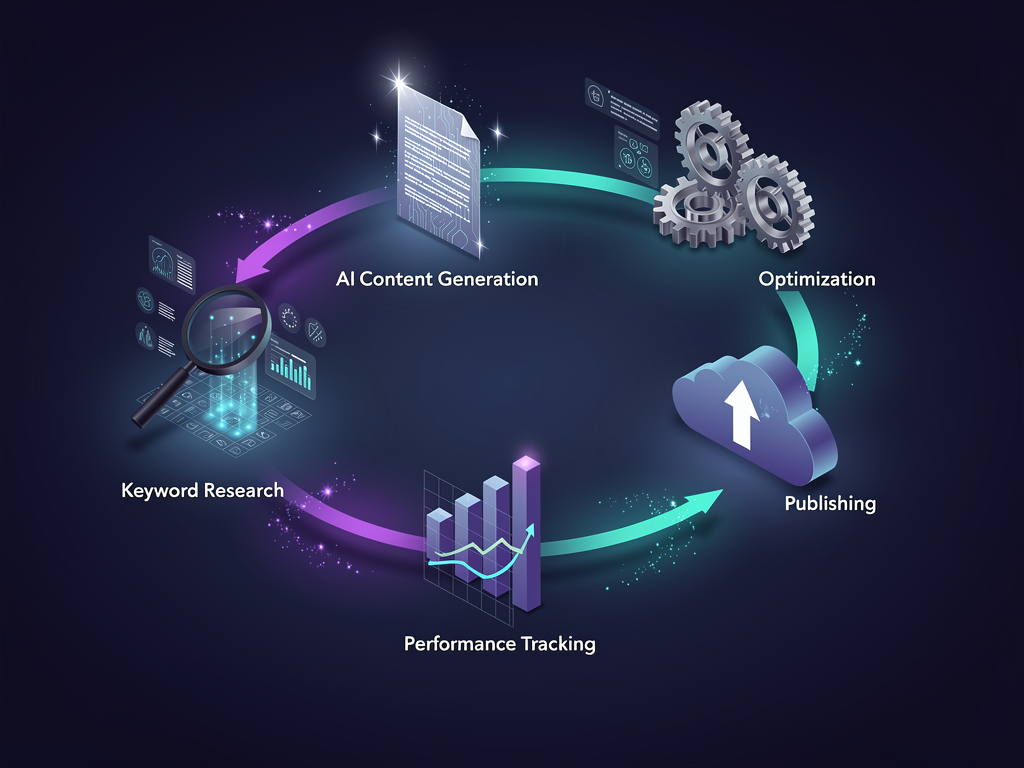
Modern AI SEO platforms automate the entire content lifecycle from research to publication.
Building an Effective AI SEO Strategy: Framework and Foundations
Implementing AI-powered SEO effectively requires more than simply subscribing to tools and hoping for results. Success demands a strategic framework that aligns automation capabilities with business objectives, audience needs, and competitive realities.
The first step involves conducting a thorough audit of your current SEO position. This means understanding which keywords you currently rank for, where your content gaps exist, how your technical foundation compares to competitors, and what your backlink profile looks like. AI tools can accelerate this analysis dramatically, but the strategic interpretation of findings requires human judgment.
Next, define clear objectives that go beyond vanity metrics. Rather than targeting arbitrary traffic numbers, focus on outcomes that matter to your business. For e-commerce stores, this might mean organic revenue from product pages. For B2B companies, it could be qualified leads generated through content. For affiliate marketers, commission-generating clicks. These objectives should guide every subsequent decision about content topics, formats, and distribution channels.
Content planning in the AI era looks different from traditional editorial calendars. Instead of brainstorming topics in isolation, effective strategies use AI to identify content opportunities systematically. This includes analyzing competitor content to find gaps, monitoring search trends to spot emerging topics, and clustering related keywords into comprehensive content hubs that establish topical authority.
The implementation phase is where automation truly shines. Once strategic direction is established, AI systems can execute at scales that would overwhelm manual approaches. A single content strategist with the right tools can now produce and publish more optimized content than entire teams could manage just a few years ago. This democratization of capability has profound implications for small businesses and lean marketing teams.
Finally, measurement and iteration close the loop. AI tools provide increasingly sophisticated analytics that connect content investments to business outcomes. Rather than waiting months to understand what works, marketers can identify patterns quickly and adjust strategies accordingly. This rapid feedback cycle accelerates learning and improves results over time.
Content Sprint Strategies: Scaling Production Without Sacrificing Quality
One of the most powerful applications of AI in SEO is the ability to execute content sprints that would be impossible through manual production. These intensive publishing campaigns can rapidly establish topical authority, capture long-tail keyword opportunities, and build the content foundation that supports broader marketing objectives.
The concept is straightforward: rather than publishing one or two articles per week and waiting years to build a comprehensive content library, AI-powered workflows enable publishing 30, 60, or even more articles per month. This accelerated pace does not mean sacrificing quality. Modern AI platforms produce content that meets or exceeds the standards of average human writers, particularly for informational content that does not require deep original expertise.
Successful content sprints require careful planning to avoid common pitfalls. Topic selection must be strategic, targeting keywords with realistic ranking potential while avoiding cannibalization of existing content. The AI system needs comprehensive context about your brand, products, and audience to produce content that aligns with your voice and objectives. Quality control processes must be in place to catch errors before publication.
The benefits of this approach extend beyond simple traffic gains. Search engines reward websites that demonstrate consistent publishing activity and comprehensive coverage of their topics. A site that publishes regularly signals ongoing relevance and commitment to serving its audience. The compound effect of many optimized articles, each capturing long-tail search traffic, can dramatically outperform strategies focused on a few high-competition keywords.
For agencies managing multiple client websites, content sprints offer a scalable service model. Rather than being limited by writer availability and editorial bandwidth, agencies can offer comprehensive content programs that deliver measurable results within months rather than years. This capability transforms the economics of SEO services and creates opportunities for differentiation in a competitive market.
Keyword Research Reimagined: AI-Powered Topic Discovery
Traditional keyword research involved exporting lists from tools, sorting by volume and difficulty, and manually identifying opportunities. This process was time-consuming, often missed valuable long-tail opportunities, and required significant expertise to execute effectively. AI has transformed this fundamental SEO activity into something far more powerful and efficient.
Modern AI keyword research begins with understanding intent rather than simply identifying terms. The tools analyze how users formulate queries, what questions they ask before and after specific searches, and what content currently satisfies those needs. This intent-focused approach reveals opportunities that volume-based research misses entirely.
Semantic clustering represents another major advancement. Rather than treating keywords as isolated targets, AI systems group related terms into topical clusters that inform content strategy. This approach aligns with how search engines understand content: not as pages targeting individual keywords, but as comprehensive resources covering topics thoroughly.
Competitive gap analysis has become dramatically more sophisticated. AI tools can analyze hundreds of competitor pages, identify topics they cover that you do not, and prioritize opportunities based on ranking potential and business value. This systematic approach ensures content investments target the highest-impact opportunities rather than relying on intuition or incomplete analysis.

AI keyword research tools reveal opportunities through semantic clustering and competitive analysis.
The speed advantage cannot be overstated. Research that once took days can now be completed in minutes. This acceleration does not just save time: it enables more thorough analysis and faster response to emerging opportunities. When a new trend emerges in your industry, AI-powered research can identify relevant keywords and inform content strategy before competitors even recognize the opportunity.
For niche site builders and affiliate marketers, this capability is particularly valuable. Success in these models depends on identifying underserved topics where relatively thin competition makes ranking achievable. AI tools excel at finding these opportunities by analyzing vast amounts of search data to surface terms that manual research would likely miss.
Content Optimization: Beyond Keywords to Comprehensive Quality
Creating content that ranks requires more than including target keywords in the right places. Search algorithms have evolved to evaluate content quality holistically, considering factors like comprehensiveness, readability, expertise signals, and user engagement. AI optimization tools address all these dimensions simultaneously.
Semantic optimization ensures content covers topics thoroughly. Rather than simply checking for keyword presence, AI tools analyze what subtopics, entities, and concepts must be included for content to be considered comprehensive. They compare your content against top-ranking pages and identify gaps that could prevent ranking success.
Readability optimization makes content accessible to your target audience. AI tools analyze sentence structure, vocabulary complexity, and formatting to ensure content is easy to consume. They suggest improvements that maintain meaning while improving clarity. This matters because user engagement signals influence rankings: content that readers abandon quickly sends negative signals to search algorithms.
Structure optimization addresses how content is organized. AI tools recommend heading structures that improve both user experience and search engine understanding. They identify opportunities for lists, tables, and other formatting elements that make content more scannable and useful. Proper structure also increases the likelihood of earning featured snippets and AI Overview citations.
Expert Insight: The best-performing content in 2026 provides answers that AI systems cannot generate on their own. Original research, proprietary data, unique case studies, and expert perspectives give your content value that pure AI-generated content cannot match.
E-E-A-T optimization (Experience, Expertise, Authoritativeness, Trustworthiness) has become increasingly important. AI tools help identify opportunities to strengthen these signals through author credentials, citations to authoritative sources, case studies demonstrating real-world experience, and trust indicators like reviews and testimonials. These elements matter more as search engines work to distinguish genuinely expert content from AI-generated fluff.
Schema markup implementation helps search engines and AI systems understand your content's meaning and context. AI tools can automatically generate appropriate schema for different content types, from articles and FAQs to products and local businesses. This structured data increases the likelihood of rich results and AI citations.
Technical SEO Automation: Maintaining a Healthy Foundation
Technical SEO remains the foundation upon which all other optimization efforts depend. A website with poor technical health will struggle to rank regardless of content quality. AI-powered tools have made maintaining technical excellence more accessible and less time-consuming than ever before.
Automated crawling and monitoring identifies issues before they impact rankings. Rather than running periodic audits and discovering problems after the damage is done, AI systems continuously monitor site health and alert you to issues as they arise. This proactive approach prevents the ranking drops that often accompany technical problems.
Page speed optimization has become increasingly sophisticated. AI tools analyze performance data, identify specific bottlenecks, and often suggest or implement fixes automatically. Given the importance of Core Web Vitals as ranking factors, this capability directly impacts search visibility.
Mobile optimization ensures your site performs well across devices. AI tools test pages on various screen sizes and connection speeds, identifying issues that could harm mobile rankings. With mobile-first indexing now standard, this analysis is essential for maintaining visibility.

AI-powered technical SEO tools provide real-time monitoring and automated issue detection.
Indexation management helps ensure your important pages are discoverable. AI tools identify pages that are not being indexed, diagnose why, and suggest solutions. They also identify pages that should not be indexed (like duplicate content or thin pages) and recommend appropriate handling.
Internal linking optimization strengthens your site's architecture. AI tools analyze your content and identify opportunities to add internal links that improve both user navigation and search engine understanding of your site's structure. Proper internal linking distributes authority throughout your site and helps search engines discover and understand your content.
For e-commerce sites with thousands of product pages, technical SEO automation is particularly valuable. Manually auditing and optimizing at this scale would be prohibitively expensive. AI tools make comprehensive technical optimization feasible regardless of site size.
Link Building in the AI Era: Automation and Exchange Networks
Backlinks remain a crucial ranking factor, but the approaches to acquiring them have evolved significantly. Manual outreach, while still valuable for high-value opportunities, cannot scale to meet the link-building needs of ambitious SEO campaigns. AI-powered tools and exchange networks have created new possibilities.
Automated outreach systems identify relevant link opportunities and personalize communication at scale. Rather than sending generic emails that recipients immediately delete, AI systems craft personalized messages that reference specific content and explain genuine mutual benefit. This personalization dramatically improves response rates.
Link exchange networks facilitate mutually beneficial relationships between complementary websites. These networks match sites with relevant, non-competing partners and coordinate exchanges that benefit both parties. The key is relevance: links between genuinely related sites provide value to users and satisfy search engine quality guidelines.
Content-based link acquisition has become more systematic. AI tools identify content formats and topics that naturally attract links, inform content strategy accordingly, and track results to refine approaches over time. This data-driven approach replaces guesswork with evidence about what actually earns links in your niche.
Digital PR automation helps secure coverage in relevant publications. AI tools monitor for relevant opportunities, craft pitches tailored to specific journalists and outlets, and track results across campaigns. This capability makes digital PR accessible to smaller organizations that could not previously afford dedicated PR resources.
For agencies and consultants, these capabilities transform link-building service offerings. Rather than selling a fixed number of manually acquired links, agencies can offer comprehensive link-building programs that combine multiple approaches and deliver results more predictably. The automation handles scale while human strategists focus on high-value opportunities and relationship building.
Measuring AI SEO Success: Metrics and Attribution
Effective measurement separates successful AI SEO implementations from expensive experiments. The sophistication of modern analytics tools enables clearer attribution between content investments and business outcomes than ever before, but only for those who implement tracking properly.
Traffic metrics provide the foundation but tell an incomplete story. Understanding not just how many visitors arrive but where they come from, what content they engage with, and how they behave after arriving reveals whether your content attracts the right audience. AI analytics tools segment traffic automatically and surface insights that would require significant manual analysis to discover.
Ranking tracking has evolved beyond simple position monitoring. Modern tools track rankings across different devices, locations, and search features (including AI Overviews). They identify ranking volatility, correlate changes with algorithm updates or content modifications, and predict future performance based on current trends.
Metric Category | Key Indicators | What They Reveal |
|---|---|---|
Visibility | Rankings, impressions, AI citations | How discoverable your content is |
Engagement | CTR, time on page, bounce rate | Whether content satisfies user intent |
Authority | Backlinks, referring domains, mentions | How trusted your site is |
Conversion | Leads, sales, sign-ups from organic | Business impact of SEO investment |
Efficiency | Cost per article, time to rank | ROI of AI-powered workflows |
Conversion attribution connects organic traffic to business outcomes. For e-commerce, this means tracking revenue from organic visitors. For B2B, it means connecting content engagement to lead generation and pipeline. For publishers, it means understanding which content drives the most valuable ad impressions or affiliate conversions.

Comprehensive analytics connect AI SEO investments to measurable business outcomes.
Content performance analysis identifies what works and what does not. AI tools analyze which topics, formats, and approaches generate the best results, informing future content strategy. This feedback loop accelerates learning and improves results over time.
Competitive benchmarking puts your performance in context. Understanding how your visibility, authority, and content compare to competitors reveals opportunities and threats. AI tools automate this analysis and alert you to significant competitive changes.
Common Pitfalls and How to Avoid Them
The power of AI SEO tools creates risks alongside opportunities. Understanding common pitfalls helps you avoid expensive mistakes and implement strategies that deliver sustainable results.
Over-reliance on automation leads to generic content that fails to differentiate your brand. AI tools excel at producing competent content at scale, but competent is rarely enough to rank for competitive terms. The solution is combining AI efficiency with human expertise: let automation handle research and drafting while humans add unique insights, original examples, and brand voice.
Ignoring quality in pursuit of quantity can trigger algorithmic penalties or simply fail to rank. Publishing hundreds of thin, repetitive articles will not build authority or attract links. Focus on comprehensive, valuable content even when using AI to accelerate production. Quality thresholds have risen, and content that would have ranked five years ago may be invisible today.
Neglecting technical foundations undermines content investments. The best content in the world will not rank on a slow, poorly-structured website with crawling issues. Ensure technical health before scaling content production. AI tools make technical auditing easier, but someone must act on the findings.
Failing to adapt to algorithm changes leaves strategies outdated. Search engines continuously evolve, and tactics that work today may become ineffective or even harmful tomorrow. Stay informed about algorithm updates and be prepared to adjust approaches accordingly. AI tools that monitor for ranking changes can provide early warning of problems.
Copying competitor strategies without understanding context leads to poor results. What works for an established authority may not work for a new site. AI competitive analysis should inform strategy, not dictate it. Consider your unique strengths, audience, and objectives when interpreting competitive data.

Avoiding common pitfalls ensures AI SEO investments deliver sustainable results.
Underestimating the importance of E-E-A-T produces content that lacks credibility. Search engines increasingly prioritize content from demonstrably expert sources. Include author credentials, cite authoritative sources, share real experience, and build trust signals throughout your content.
Industry-Specific Applications: Tailoring AI SEO to Your Niche
Different industries and business models require different approaches to AI-powered SEO. Understanding how to adapt general principles to your specific context maximizes the value of your investment.
E-commerce stores benefit from AI-generated product descriptions, category page optimization, and blog content that captures informational searches related to their products. The challenge is maintaining unique content across potentially thousands of similar products. AI tools that can generate genuinely differentiated descriptions while maintaining brand voice are particularly valuable.
B2B companies typically target longer sales cycles and more sophisticated buyers. Content must demonstrate expertise and address complex decision-making processes. AI tools help produce the comprehensive guides, case studies, and thought leadership content that B2B buyers seek. Integration with marketing automation ensures content supports lead nurturing throughout the funnel.
Local businesses need content that establishes relevance for geographic searches. AI tools can help create location-specific content at scale, optimize Google Business Profiles, and build local citations. The key is balancing automation efficiency with genuine local relevance that resonates with community audiences.
SaaS companies require consistent content production to support product-led growth and competitive positioning. AI tools enable the regular publishing cadence that builds authority in competitive software categories. Integration with product documentation and help content creates comprehensive resources that serve both SEO and customer success objectives.
Affiliate marketers and niche site builders depend on efficient content production to capture long-tail opportunities across their topics. AI tools enable the volume necessary to build comprehensive niche sites while maintaining quality standards that satisfy both search algorithms and user expectations. The economics of affiliate marketing often depend on production efficiency that only AI can provide.
Agencies and consultants can leverage AI SEO tools to scale service delivery and improve client results. The key is developing workflows that combine AI efficiency with the strategic expertise that justifies agency fees. Agencies that simply resell AI-generated content without adding value will struggle against clients who adopt the same tools directly.

AI SEO strategies adapt to serve the unique needs of different industries and business models.
The Future of AI SEO: Trends Shaping 2026 and Beyond
Understanding where AI SEO is heading helps you prepare for changes before they arrive. Several trends are already reshaping the landscape and will continue to evolve in the coming years.
Generative Engine Optimization (GEO) has emerged as a distinct discipline alongside traditional SEO. As more users interact with AI assistants rather than traditional search results, optimizing for citations in AI-generated answers becomes increasingly important. This requires content strategies that make your information the authoritative source AI systems reference.
Multimodal content optimization addresses the growing importance of images, video, and audio in search. AI tools increasingly help optimize across all content formats, not just text. As search engines become better at understanding and ranking multimedia content, comprehensive optimization becomes essential.
Personalization at scale enables content that adapts to different audience segments. AI tools can generate variations of content tailored to different industries, roles, or use cases. This capability allows more targeted content strategies without proportionally increasing production costs.
Real-time optimization responds to changing search landscapes faster than ever. AI systems that monitor rankings, detect algorithm changes, and suggest or implement adjustments automatically enable more agile SEO strategies. The days of quarterly strategy reviews may give way to continuous optimization.
Integration across marketing channels connects SEO with broader marketing efforts. AI platforms increasingly unify content creation, social media, paid advertising, and email marketing. This integration enables more coherent customer experiences and more efficient marketing operations.
Implementing Your AI SEO Strategy: A Practical Roadmap
Moving from understanding to implementation requires a structured approach. This roadmap provides a framework for organizations at any stage of AI SEO adoption.
Phase 1: Foundation (Weeks 1-2) involves auditing your current position and selecting appropriate tools. Assess your technical SEO health, content inventory, backlink profile, and competitive landscape. Identify the AI tools that address your specific needs and budget. Establish baseline metrics against which you will measure progress.
Phase 2: Configuration (Weeks 3-4) focuses on setting up your chosen tools and workflows. Configure AI systems with your brand guidelines, target keywords, and content preferences. Establish publishing workflows that connect content creation to your CMS. Set up tracking and reporting to monitor results.
Phase 3: Pilot (Weeks 5-8) tests your approach at limited scale. Publish a batch of AI-assisted content and monitor performance closely. Identify what works and what needs adjustment. Refine prompts, workflows, and quality control processes based on results.
Phase 4: Scale (Weeks 9-16) expands successful approaches. Increase content production volume while maintaining quality standards. Expand keyword targeting based on pilot learnings. Begin building backlinks systematically to support new content.
Phase 5: Optimize (Ongoing) continuously improves results. Analyze performance data to identify opportunities. Update existing content based on ranking performance. Refine strategies based on algorithm changes and competitive movements. Expand into new topic areas as authority builds.

A structured implementation roadmap ensures successful AI SEO adoption.
Throughout this process, maintain flexibility. The AI SEO landscape evolves rapidly, and strategies that work today may need adjustment tomorrow. Build learning and adaptation into your processes rather than treating any approach as permanent.
Selecting the Right AI SEO Platform: Evaluation Criteria
The market offers numerous AI SEO tools, each with different strengths and limitations. Selecting the right platform for your needs requires evaluating options against criteria that matter for your specific situation.
Accuracy of data should be verified against your own Google Search Console numbers. If keyword volumes, ranking positions, or traffic estimates differ significantly from your actual data, the tool's recommendations may lead you astray. Request trials or demos that allow you to validate data quality before committing.
Content quality varies dramatically between platforms. Request sample outputs for topics in your niche and evaluate them critically. Does the content demonstrate genuine understanding of the subject? Would you be comfortable publishing it under your brand? Does it require extensive editing, or is it nearly publication-ready?
Integration capabilities determine how smoothly the tool fits into your existing workflows. Can it publish directly to your CMS? Does it integrate with your analytics and reporting tools? The best features are worthless if they create friction in your processes.
Scalability matters if you plan to expand usage over time. Understand pricing at different volume levels and ensure the economics work for your growth plans. Some tools become prohibitively expensive at scale, while others offer volume discounts that improve ROI as usage increases.
Support and training affect how quickly you can realize value. Evaluate the quality of documentation, availability of training resources, and responsiveness of support teams. Complex tools require investment to master, and good support accelerates that process.

Systematic evaluation ensures you select the AI SEO platform that best fits your needs.
Backlink capabilities deserve special attention given the continued importance of links for rankings. Does the platform offer link-building features? Does it participate in exchange networks that can accelerate link acquisition? These capabilities can significantly impact results.
Conclusion
The transformation of search engine optimization through artificial intelligence represents both an opportunity and an imperative. Organizations that embrace AI-powered workflows can achieve results that would be impossible through manual approaches alone, while those that cling to outdated methods will find themselves increasingly outcompeted.
The key to success lies not in replacing human judgment with automation, but in combining the efficiency of AI with the strategic insight that only humans can provide. AI excels at research, analysis, content generation, and distribution at scale. Humans excel at understanding business context, maintaining brand voice, ensuring accuracy, and making strategic decisions that align with broader objectives.
For SEO agencies, content marketing managers, small business owners, affiliate marketers, and all the other professionals navigating this landscape, the path forward is clear. Invest in understanding AI capabilities, select tools that match your specific needs, implement structured workflows that maintain quality at scale, and continuously adapt as the technology and search landscape evolve.
The organizations that thrive in 2026 and beyond will be those that view AI not as a threat to their expertise but as an amplifier of their capabilities. The search rankings are there to be won. The question is whether you will use every available advantage to claim them.

AI-powered SEO enables teams of any size to achieve remarkable search visibility results.
Frequently Asked Questions
How does AI-generated content affect search rankings in 2026?
Search engines in 2026 do not penalize content simply for being AI-generated. What matters is quality, accuracy, and value to users. Google's guidelines focus on whether content is helpful, regardless of how it was produced. AI-generated content that is well-researched, factually accurate, and genuinely useful can rank just as well as human-written content. However, thin AI content that merely restates information available elsewhere, contains errors, or fails to provide unique value will struggle to rank. The key is using AI as a tool to enhance content quality and production efficiency rather than as a shortcut to publish low-effort material. Organizations seeing the best results combine AI efficiency with human oversight to ensure brand voice, accuracy, and strategic alignment.
What is the difference between traditional SEO and Generative Engine Optimization?
Traditional SEO focuses on ranking in organic search results, the familiar blue links that have dominated search for decades. Generative Engine Optimization (GEO) focuses on being cited and referenced in AI-generated answers, whether in Google's AI Overviews, ChatGPT responses, or other AI assistant outputs. The distinction matters because user behavior is fragmenting across these channels. Effective strategies in 2026 address both: optimizing content structure, authority signals, and technical foundations for traditional rankings while also ensuring content is formatted and positioned to be cited by AI systems. This often means providing clear, authoritative answers that AI systems can extract and reference, along with unique insights that make your content the preferred source for AI citations.
How much does AI SEO automation typically cost for small businesses?
Costs vary significantly based on needs and chosen tools. Entry-level AI content generation tools start around $30 to $100 per month and can handle basic content production for small sites. Comprehensive platforms that include keyword research, content optimization, publishing automation, and backlink features typically range from $100 to $500 monthly for small business usage. Enterprise platforms with advanced features can cost thousands per month. The key consideration is ROI rather than absolute cost. A $200 monthly investment that enables publishing 30 optimized articles, each potentially generating organic traffic for years, often delivers returns that far exceed the cost. Many platforms offer free trials or starter tiers that allow testing before committing to paid plans.
Can AI SEO tools replace human SEO specialists entirely?
AI tools cannot fully replace human SEO specialists, but they dramatically change what those specialists do. Tasks that once consumed most of an SEO professional's time, such as keyword research, content briefing, basic optimization, and technical auditing, can now be largely automated. This frees specialists to focus on strategic work: understanding business objectives, interpreting competitive landscapes, making judgment calls about content direction, and managing relationships with stakeholders. The most effective model combines AI efficiency with human expertise. AI handles volume and consistency while humans provide strategic direction, quality control, and the creative insights that differentiate truly excellent content from merely competent material. Specialists who embrace AI tools become more valuable, not less.
How long does it take to see results from AI-powered SEO strategies?
Timeline expectations should be realistic: SEO remains a medium to long-term investment regardless of the tools used. Most organizations begin seeing measurable improvements in rankings and traffic within three to six months of implementing comprehensive AI SEO strategies. However, several factors influence this timeline. New domains typically take longer to build authority than established sites. Competitive keywords require more time and content investment than long-tail opportunities. Technical issues that are not addressed can delay results indefinitely. The advantage of AI-powered approaches is not necessarily faster rankings for individual pages, but the ability to pursue many more opportunities simultaneously. A strategy targeting hundreds of long-tail keywords will typically generate meaningful traffic faster than one focused on a handful of competitive terms, even if individual pages take the same time to rank.
What role do backlinks play in AI-era SEO, and how can AI help build them?
Backlinks remain a crucial ranking factor in 2026, though their role has evolved. Search engines have become better at evaluating link quality, making manipulative link-building tactics increasingly risky while rewarding genuine editorial links from relevant, authoritative sources. AI tools help with link building in several ways. They identify relevant link opportunities by analyzing competitor backlink profiles and finding sites likely to link to your content. They personalize outreach at scale, crafting messages that reference specific content and explain genuine mutual benefit. Some platforms facilitate link exchange networks that connect complementary websites for mutually beneficial linking relationships. AI also helps create content formats that naturally attract links, such as original research, comprehensive guides, and useful tools. The combination of AI-powered outreach efficiency and strategic focus on link-worthy content makes building a healthy backlink profile more achievable for organizations of all sizes.
Ready to Transform Your SEO Results with AI-Powered Automation?
Stop spending countless hours on manual content creation and optimization. SeoSmart creates brand-tailored 5,000-word articles complete with images, internal links, and YouTube videos, then publishes them automatically and builds backlinks through an integrated exchange network. Whether you need 30 or 60 articles per month, the platform handles everything from keyword research to publication while you focus on growing your business. Start with 500 free credits and discover how automated content sprints can accelerate your path to page one rankings.
Subscribe to our newsletter
Subscribe to our newsletter and stay up-to-date with the latest news and updates.